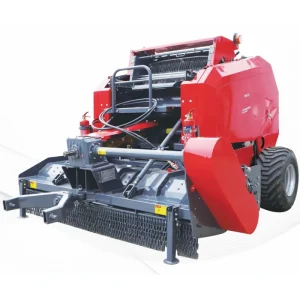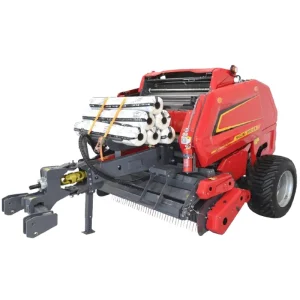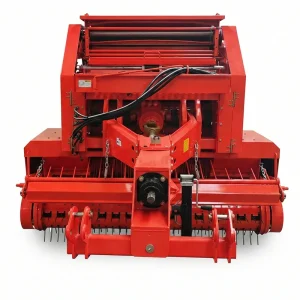
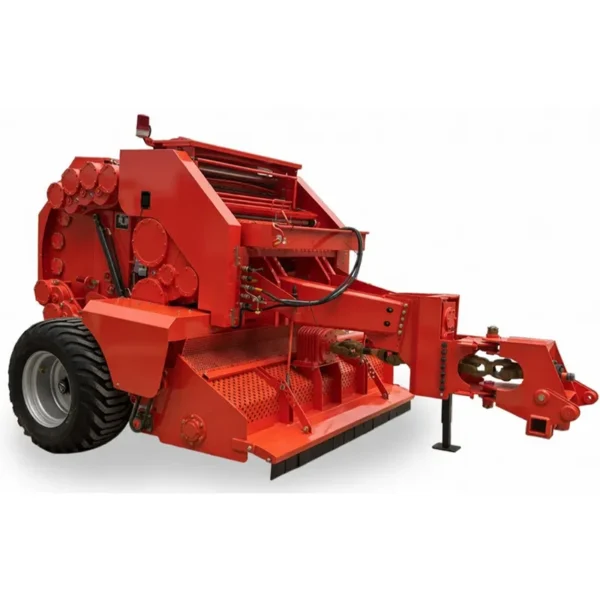
Descrição
Mode A — Spring Tooth
Hay, Straw & Haylage
Standard spring-tooth pickup lifts windrowed hay and straw gently from the ground. Tines sweep and accelerate material without aggressive cutting action, which minimizes leaf shatter on dry alfalfa and orchardgrass — important when forage leaf fraction drives feeding value for dairy or horses.
Mode B — Hammer Claw
Standing Corn Stover Direct
18 rotating hammer claws sever standing corn stalks at ground level and collect them in a single continuous pass. No post-harvest shredding step, no separate raking pass — the machine cuts and bales in one operation, reducing the labor and fuel cost of a traditional two-step stover collection process.
720 RPM PTO · Net Wrap Standard · Electronic Density Sensor · Towed Drawbar · Machine Weight: 10,054 lb
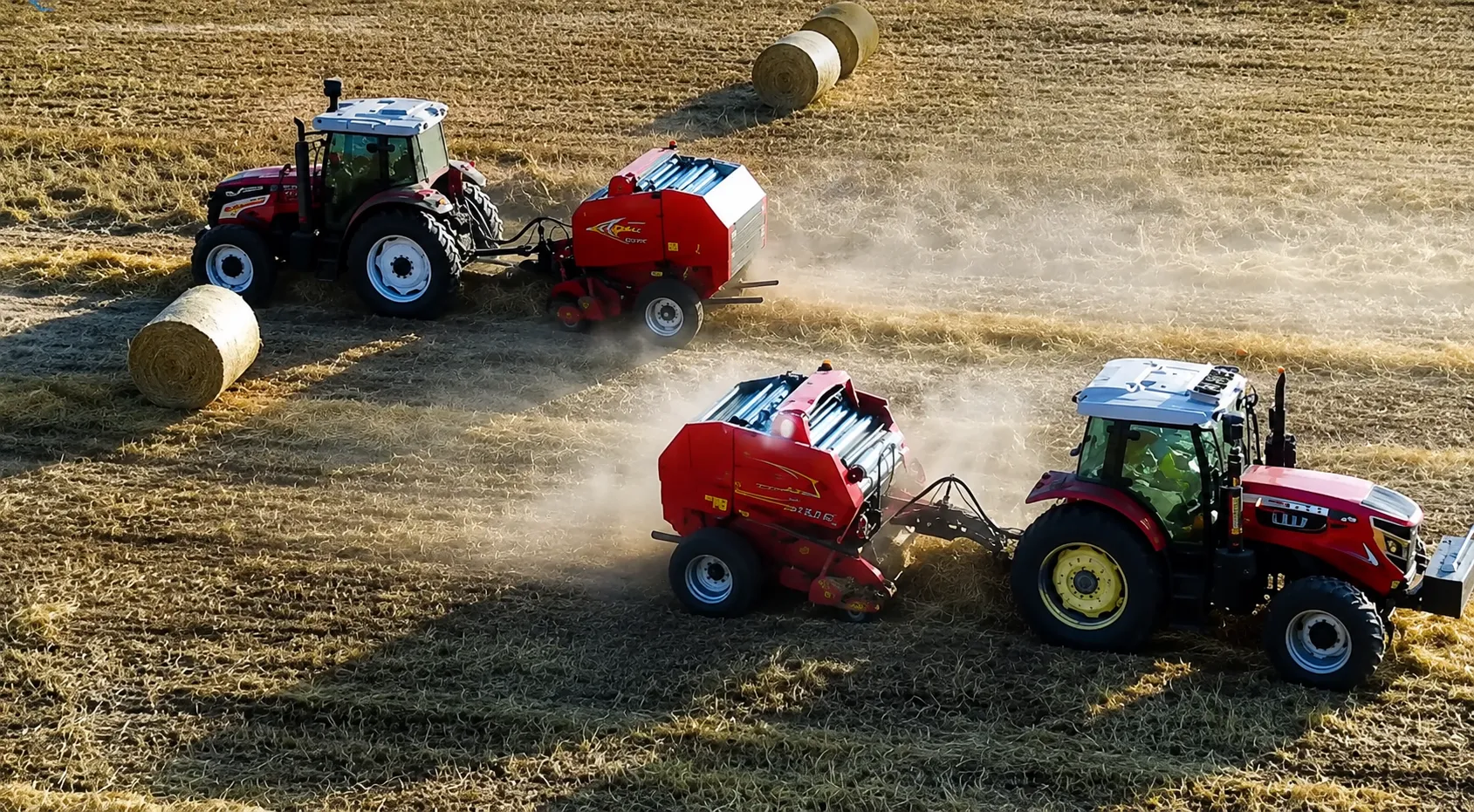
Corn stover baling with a conventional spring-tooth round baler requires two field passes before you ever bale: one with a stalk shredder to cut the standing stalks down, and another with a rake to consolidate the shredded material into a windrow. Only then can the baler follow. On large corn acreages, those two extra passes represent significant fuel, equipment, and labor cost — often enough to make stover collection marginal even when the bale market price is reasonable.
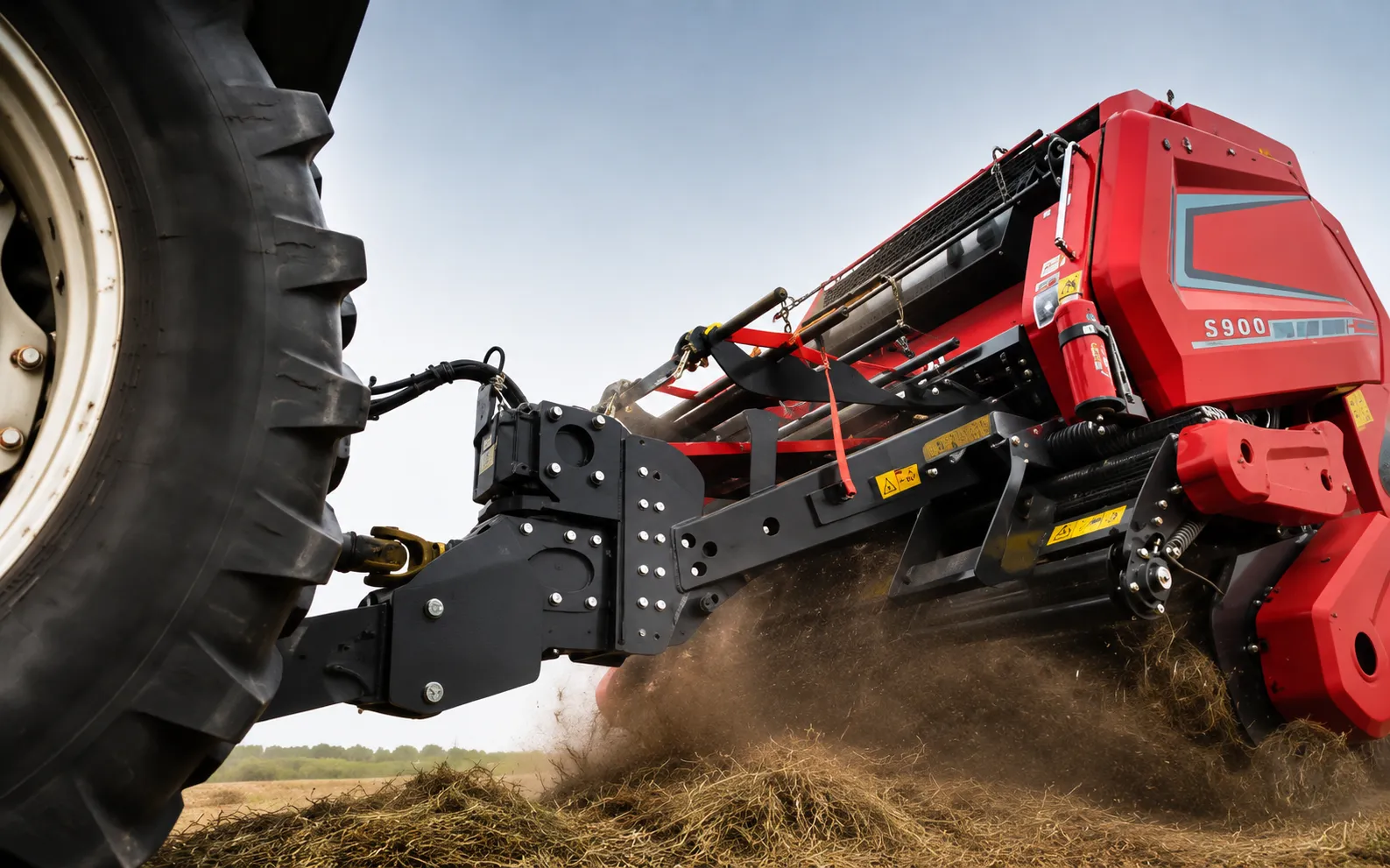
The 9YH-1.25B eliminates both of those steps when operated in hammer claw mode. Eighteen rotating hammer claws mounted across the full pickup width sever standing corn stalks at or near ground level and collect them directly into the feed system in a single continuous pass. The same auger + tooth roller + drum three-stage intake that handles hay without blockages also processes the cut stover material, distributing it across the 1,250 mm chamber width before compression. The machine bales post-combine standing residue in one operation — no shredder, no rake, no second fuel tank required.
When hay season arrives, the hammer claw assembly swaps out for the spring-tooth pickup head. The changeover is a mechanical field swap — no special tools required — and the machine resumes standard hay and straw baling with the same 18-roller fixed chamber, the same automatic net wrap system, and the same sensor-controlled density management that applies to both modes.
At ≥120 HP PTO requirement, the 9YH-1.25B requires a heavier tractor than the standard 9YG-1.25 — the higher power demand reflects the energy needed to drive the hammer claws through standing stalks at field speed. In spring-tooth mode the same machine can run comfortably on tractors from 120–150 HP, making it versatile through the full season. For the full product range, see Brazil Ever-Power Farm Balers’ product catalog.
Technical Specifications
| # | Parameter | Unit | Valor |
|---|---|---|---|
| 1 | Model Name | — | 9YH-1.25B Round Baler (Hammer Claw) |
| 2 | Hitch Type | — | Towed (Drawbar) |
| 3 | Largura de captação | mm / in | 2,240 mm (88.2 in) |
| 4 | Pickup Type | — | Spring Tooth & Hammer Claw (Interchangeable) |
| 5 | Hammer Claw Count | pcs | 18 |
| 6 | Feed System | — | Auger + Tooth Roller + Drum (3-Stage) |
| 7 | Chamber Type | — | Fixed-Chamber Roller |
| 8 | Chamber Width | mm / in | 1,250 mm (49.2 in) |
| 9 | Chamber Diameter | mm / in | 1,200 mm (47.2 in) |
| 10 | Number of Rollers | pcs | 18 |
| 11 | Roller Diameter | mm | 222 mm (8.7 in) |
| 12 | Wrapping System | — | Automatic Net Wrap (Standard) |
| 13 | Tractor Power Required | kW / HP | ≥88.2 kW (≥120 HP) |
| 14 | Machine Weight | kg / lb | 4,558 kg (10,054 lb) |
| 15 | PTO Speed | RPM | 720 |
| 16 | Overall Dimensions (L×W×H) | mm | 5,250 × 2,700 × 2,350 (working) |
| 17 | Bale Density Control | — | Electronic Sensor |
| 18 | Bale Size (Dia. × Width) | mm / in | Φ 1,200 × 1,250 mm (47 × 49 in) |
| 19 | Densidade do fardo | kg/m³ | 115–200 |
| 20 | Productivity | bales/hr | 40–80 |
| 21 | Track Width | mm | 2,450 |
| 22 | Operating Speed | km/h / mph | 5–20 km/h (3–12 mph) |
| 23 | Net Wrap Specification | — | 2,000 × 1.25 m per bale |
The Hammer Claw Mechanism
How It Works
The 18 hammer claws are mounted on a rotating shaft assembly positioned at the front of the pickup frame, in place of the spring-tooth pickup when the machine is in stover mode. The claws rotate at high speed relative to the ground and tractor forward travel, striking standing corn stalks at or near the base and severing them through impact force rather than blade cutting.
After severance, the claws continue to sweep the cut material upward and rearward into the three-stage feed system. The auger spreads the collected stover laterally across the chamber width; the tooth roller and drum deliver it into the compression zone. Because all three feed stages are active regardless of which pickup is installed, the intake characteristics in stover mode are similar to hay mode — consistent distribution, reduced blockage risk in dense material.
Operational Economics
A conventional stover collection workflow requires three passes: shredder, rake, baler. The 9YH-1.25B in hammer claw mode replaces all three with one. The economic case depends on your operation’s cost structure, but for a corn operation at 400–800 acres of stover collection per season, the fuel, labor, and machinery costs of the two eliminated passes are material.
Why 120 HP Minimum
The hammer claw assembly draws significantly more power than a spring-tooth pickup at the same forward speed. Each claw impact event transfers energy from the rotating shaft into the stalk — the shaft must maintain constant rotational speed through each impact, which requires higher sustained PTO torque than passive tine sweeping. The ≥120 HP minimum reflects the actual power demand in dense standing stalks at normal operating speeds of 5–12 km/h. Running the machine below 120 HP in stover mode risks PTO stalling in thick corn rows or causing the torque demand to exceed the tractor’s capacity, straining both the tractor and the baler’s driveline. In spring-tooth mode on hay, the effective minimum drops to approximately 100 HP with the same machine.
Pickup Swap Procedure
The transition between spring-tooth and hammer claw modes is a field-level mechanical swap. The process involves removing the front pickup frame assembly — which holds either the spring-tooth tine bar or the hammer claw shaft — and replacing it with the other. Key steps:
- Disengage PTO and lower pickup frame to transport position
- Remove mounting bolts on pickup frame front mounts (typically 4–6 bolts)
- Slide out existing pickup assembly from frame rails
- Slide in replacement assembly and secure mounting bolts
- Connect PTO drive link to new assembly
- Adjust gauge wheel height for crop type before field entry
Experienced operators typically complete the swap in 30–45 minutes without special tools. Recommended to perform the swap in a shop or level surface rather than in the field.
Field Operation by Mode
Mode A — Spring Tooth (Hay & Straw)
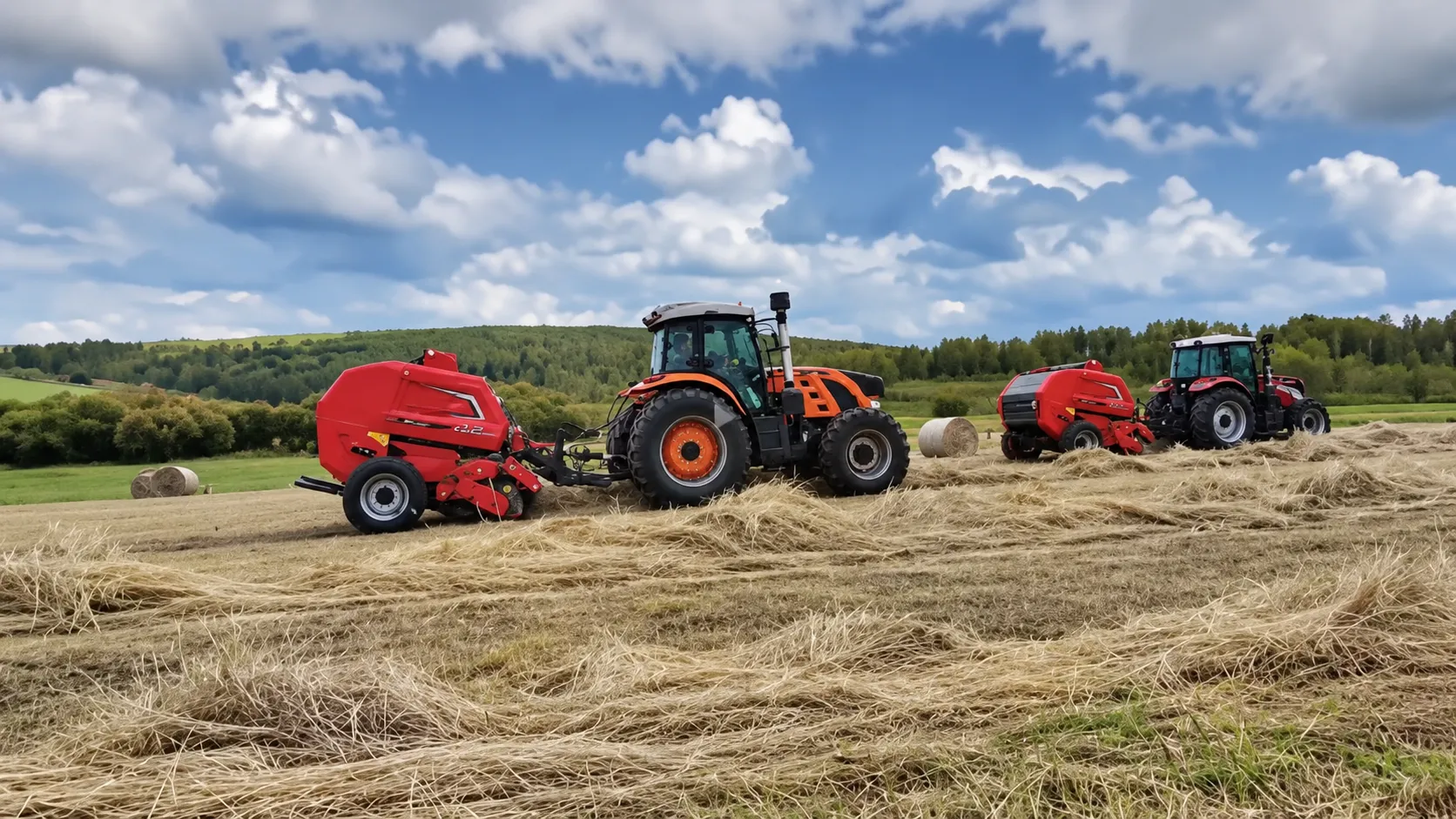
Set gauge wheel height for crop type. Dry, low-profile windrows: lower position to ensure tine contact. Thick, fluffy windrows: raise slightly to avoid soil pickup at ground contact. Enter windrow at 5–12 mph forward speed.
Three-stage feed (auger → tooth roller → drum) distributes material across chamber width. Maintain steady forward speed — surging produces uneven bale cores. Monitor intake flow via cab camera or rearview mirror.
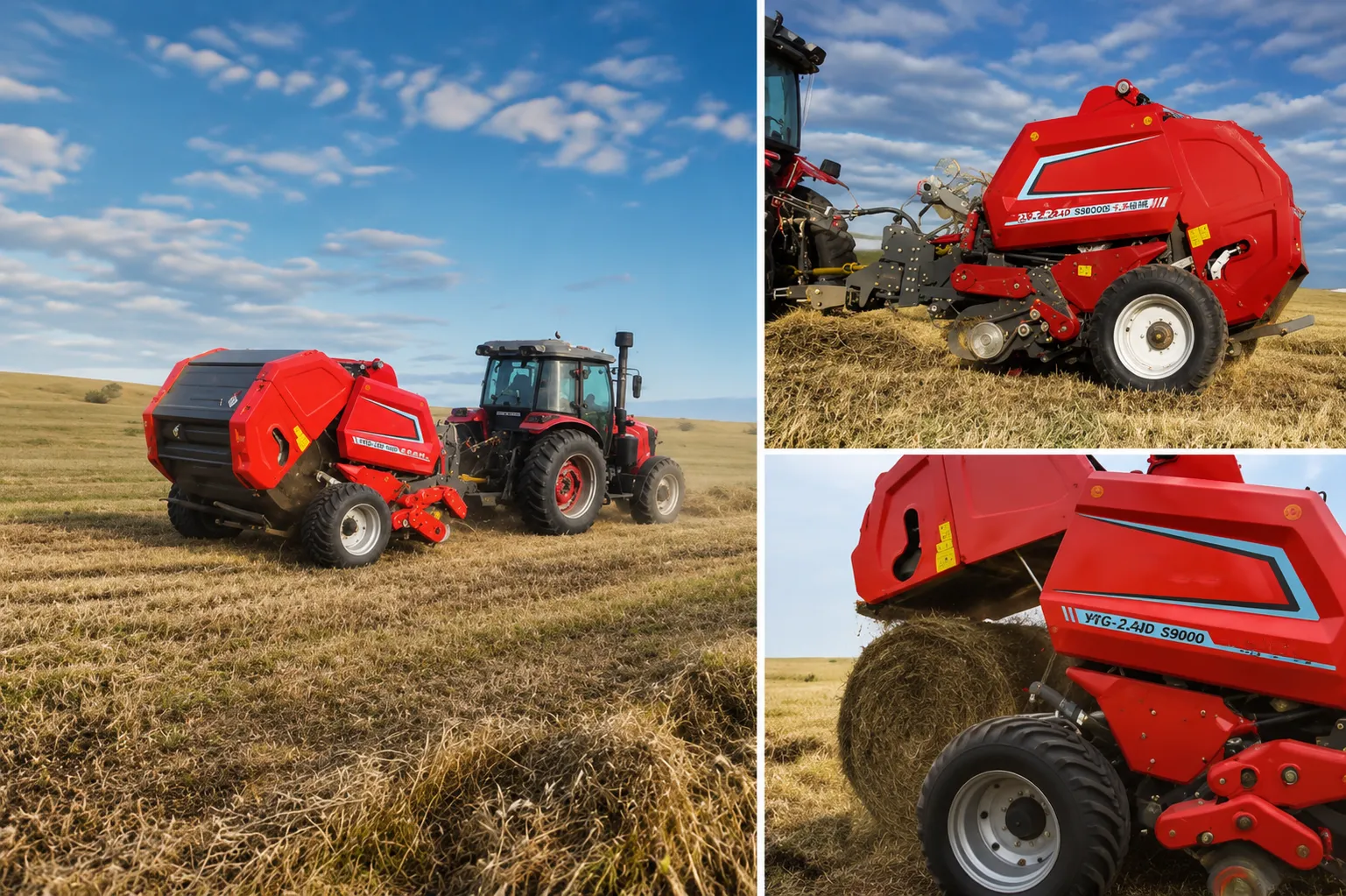
Density sensor triggers net wrap automatically at preset threshold. Slow to near-idle during wrap. Gate opens, bale ejects, gate closes. Resume forward travel. Standard cycle: 15–20 seconds net wrap to gate closed.
Mode B — Hammer Claw (Standing Corn Stover)
Confirm hammer claw assembly is installed and secured. Set claw height to skim just above soil surface — too high misses stalk bases, too low causes soil ingestion and rapid claw wear. Pre-operation: check claw fasteners are torqued per spec; a loose claw at operating RPM is a safety hazard.
Engage PTO at 720 RPM with machine stationary. Allow claw assembly to reach operating speed before entering the field. Enter corn rows at 4–8 km/h (2.5–5 mph) — stover mode runs slower than hay mode due to the impact energy demand of severing stalks. Drive at consistent speed; do not surge through thick rows.
Chamber fills with cut stover through the three-stage feed. Density sensor triggers wrap at target threshold. In stover mode, bale formation time is typically longer than hay mode due to lower material density — expect 35–55% fewer bales per hour compared to hay. Gate ejects bale as normal.
Patents & Manufacturing
In-House Design — Close to 100 Utility Patents
Brazil Ever-Power Farm Balers Co., Ltd develops all baler and harvesting machinery designs internally through its autonomous regional R&D center. The company holds close to 100 utility patents covering intake mechanisms, chamber design, driveline components, and related agricultural machinery technology. All production is performed at the company’s 32,000 m² in-house facility equipped with CNC laser cutting, robotic welding, and electrostatic coating. No core structural or mechanical components are fabricated by third parties.
Certifications: ISO 9001, Two-Informatization Integration Level A, AAA Credit Enterprise, National High-Technology Enterprise.

Suitable Crops by Mode
Alfalfa, brome, orchardgrass, fescue, bermudagrass, timothy, mixed pasture. Gentle tine action preserves leaf fraction in dry, brittle forage crops.
Wheat, oat, barley straw for bedding; second/third-cut alfalfa or grass at 30–45% moisture for baleage. Fixed-chamber handles wet material without belt-slip issues.
Cereal rye, triticale, sorghum-sudan in windrow. Three-stage feed handles tangled, fibrous terminations more smoothly than single-stage intakes.
Post-combine standing corn stalks harvested directly without prior shredding or raking. The primary application for the hammer claw mode — one pass, no pre-processing steps required.
Upright sorghum stubble and similar standing fibrous crop residue that has not yet fallen or been raked to windrow. The hammer claw’s impact mechanism can handle stems up to approximately 25 mm base diameter at normal operating speeds.
Using the hammer claw assembly on already-raked windrows is possible but not optimal — the claw’s cutting action shreds material unnecessarily, reducing bale uniformity compared to using the spring-tooth pickup on the same material. Swap back to spring-tooth for any windrowed crop.
Maintenance — Hammer Claw Specific
- Inspect all 18 hammer claws for cracks, bends, or tip wear — a damaged claw can fragment at operating RPM, creating a serious safety hazard; replace any claw showing visible damage before entering the field
- Check mounting bolt torque on all claw fasteners — vibration loosens claw bolts faster than any other fastener on the machine
- Verify claw height adjustment is set for the corn row’s stalk height and desired cutting level
- Confirm PTO shaft guard is intact — the higher PTO demand in stover mode increases shaft stress
- Re-torque all claw fasteners — stover mode runs at 20-hour re-torque intervals vs 50-hour for standard spring-tooth operation
- Inspect claw tips for wear — worn tips reduce cutting efficiency and increase power demand; replace when tip length is reduced by more than 15%
- Clean stover debris from claw shaft assembly — impacted material between claws increases rotating mass and imbalance
- Check three-stage feed system for stover fibres wrapped around auger or drum shafts
- Replace any claw showing more than 20% tip wear — do not carry worn claws into the next season
- Inspect claw shaft bearings before storing the hammer claw assembly — the shaft runs at high speed under impact loading, which accelerates bearing wear compared to the spring-tooth shaft
- Clean and dry all metal surfaces on the claw assembly before storage — corn stalks carry more moisture and soil than hay, accelerating corrosion on stored components
- Apply anti-corrosion spray to claw shaft and mounting hardware during off-season storage
Operator Reviews
Central Illinois — Corn & Soybean, 2,200 acres, stover baling for cattle operation
★★★★★
I bought the 9YH-1.25B specifically for the hammer claw function. We have 800 acres of corn stover we collect each fall for our beef cattle bedding and feed program. The old approach — shredder pass, rake pass, baler — was three pieces of equipment and three fuel loads per field. The hammer claw mode collapses that to one pass. First season on it I ran 620 acres of standing stover with the claw setup and the time savings alone paid for a meaningful chunk of the machine’s cost. Bale quality in stover mode is consistent — the three-stage feed handles the cut material without the lateral density problems I had with a conventional pickup on raked stover. In the spring I swap to spring-tooth for first-cut alfalfa on our hay ground and it works exactly like a standard baler. The swap takes me about 40 minutes with one helper. My only comment on the claw mode: you have to check the claw bolts frequently — every session, not every 50 hours. That’s the main maintenance difference versus hay mode.
Northern Indiana — Hay & Corn Rotation Farm, 750 acres
★★★★☆
For a mixed hay-and-corn operation like ours, the 9YH-1.25B’s versatility is its main selling point. We use it in spring-tooth mode for 350 acres of alfalfa and brome, then swap to hammer claw for 400 acres of corn stover in October. Both modes perform well. The spring-tooth hay baling is clean and straightforward — bale quality has been consistently good and the net wrap automation works without issues. The stover mode does run significantly slower than hay — we average about 35–40 bales per hour in stover versus 65–70 in hay, which is realistic given the stalk-cutting demand. I’m giving four stars rather than five because the pickup swap took us longer than expected the first time — closer to 90 minutes — though by the second swap we were at 45 minutes. The learning curve is real; I’d recommend doing a trial swap before you actually need to switch modes under time pressure.
Western Iowa — Corn Stover Custom Baling, 1,800 acres/season
★★★★★
I custom-bale corn stover for multiple operations in western Iowa. The economics of that work depend on minimizing passes, and the 9YH-1.25B in hammer claw mode is the right tool for it. I charge customers for one pass rather than three, which makes the service competitive against traditional methods, and my actual cost is one tractor operator for one pass, not three. The machine has run 1,800 acres of standing stover in its first season with no major mechanical problems. Claw wear is a real cost to manage — I’ve replaced six claws over the season, which is acceptable but should be budgeted. The three-stage feed handles the cut material cleanly; I haven’t had a chamber jam in stover mode in 1,800 acres. Strongly recommend for anyone in the custom stover market.
Central Nebraska — Hay Primary, Occasional Stover, 550 acres
★★★★☆
I bought the 9YH-1.25B primarily as a hay baler with stover capability as a secondary use. In spring-tooth mode it’s been a solid hay baler — comparable in performance to the standard 9YG-1.25 as far as I can tell from comparing with a neighbor who runs one. In stover mode I’ve only used it for about 80 acres on my own corn ground, which is a smaller-scale test. It worked as described — no pre-shredding needed, consistent bales from standing stalks. The 120 HP minimum is real; I had one afternoon where I tried running it with a 110 HP tractor in stover mode and it was noticeably struggling. My 130 HP handles it without strain. I’m at four stars because the ≥120 HP requirement limits which of my older tractors I can run it with — just worth knowing before purchase.
Southeast Missouri — Hay Only Operation, 400 acres
★★★☆☆
I’ll be direct: I bought the 9YH-1.25B thinking I’d add stover baling as a side revenue stream, but I don’t actually have corn on my ground and my neighbors who do weren’t interested in paying for the service at a rate that covered the additional time. So I’ve been running it exclusively in spring-tooth hay mode for 400 acres of mixed grass. As a hay baler it works fine — no complaints about bale quality or the feed system. But I’m carrying the weight, complexity, and maintenance of the hammer claw assembly that I don’t use, and I paid more than the standard 9YG-1.25 for capability I haven’t deployed. Three stars reflects that the machine works well but I chose the wrong model for my operation. If you don’t have a real stover baling use case, the standard 9YG-1.25 is the better buy at lower cost.
Frequently Asked Questions
Does the 9YH-1.25B come with both the spring-tooth and hammer claw assemblies?
Yes. The machine ships with both pickup assemblies included — 18 hammer claws are supplied as part of the standard package. One assembly is installed at the factory (confirm which at time of order); the other ships as a companion unit for field swap. No additional purchase is required to access both modes.
Can the hammer claws be replaced individually, or must the whole assembly be replaced?
Individual claws are replaceable. The 18 claws are mounted independently on the rotating shaft assembly and each is secured with its own fastener set. Worn or damaged claws can be swapped individually without removing the entire assembly. We recommend keeping a set of spare claws (6–8 units) on hand during stover season, as claw wear rate varies significantly with soil conditions — rocky or abrasive soil accelerates tip wear. Individual claw replacement kits are available through the spare parts program.
How deep below the soil surface do the claws cut?
The claws are designed to sever stalks at or just above soil level, not to penetrate the soil surface. The height adjustment on the claw assembly sets the minimum clearance above ground — typically 25–50 mm in normal field conditions. Deliberately lowering the claws into soil contact significantly accelerates wear, increases power demand, and can introduce soil debris into the bale. Set the height to skim just above the surface and adjust upward slightly if you observe soil ingestion at the pickup.
How much slower is stover mode compared to hay mode?
Expect 35–55% lower bale output per hour in stover mode compared to hay mode. In hay mode, the machine produces 40–80 bales per hour. In stover mode, practical throughput depends on corn row density, stalk height, and tractor power — most operators report 25–45 bales per hour in typical corn residue conditions at 4–8 km/h forward speed. The lower productivity is offset by eliminating the shredder and rake passes; total field time per bale produced is typically lower in single-pass stover mode than in three-pass conventional collection.
Can the machine bale already-shredded and raked stover in hammer claw mode?
The machine can physically bale raked stover with the hammer claw installed, but the result is suboptimal. The hammer claw’s rotating impact action shreds windrowed material unnecessarily, breaking it into shorter pieces than needed and creating irregular bale density. If the stover is already in windrows, swap to the spring-tooth pickup for that material — the spring-tooth handles raked stover the same way it handles raked hay, with better bale uniformity than the claw assembly produces on flat windrowed material.
What is the stover bale’s typical weight and density?
Corn stover bales from the 9YH-1.25B in hammer claw mode typically weigh 600–850 lb (270–385 kg) at the density range of 115–200 kg/m³. Actual weight varies with corn hybrid, moisture at harvest, and sensor density setpoint. Stover bales are generally lighter than equivalent-size hay bales at the same density setting because corn stover has lower intrinsic density per unit volume compared to compressed grass or alfalfa. The Φ1,200 × 1,250 mm bale format fits standard flatbed trailers and handles cleanly with a round bale spike or grapple.
Should I buy the 9YH-1.25B or the standard 9YG-1.25?
Buy the 9YH-1.25B if you have a genuine annual use case for standing corn stover direct harvest — own ground to collect, a customer base for the service, or a livestock operation that needs stover bedding economically. The premium over the standard 9YG-1.25 pays back through eliminated equipment passes in stover operations. Buy the 9YG-1.25 if you bale only hay, straw, and raked stover — the spring-tooth pickup handles all of those without the claw assembly’s additional weight, complexity, and maintenance demands.
How do I order spare hammer claws?
Hammer claw replacement kits are available through Brazil Ever-Power Farm Balers Co., Ltd’s spare parts program. Order directly through the sales team. Standard lead time to US destinations is 10–18 business days. Given the unpredictable wear rate in stover conditions, we recommend ordering a spare claw kit (6–8 claws minimum) before the start of each stover season rather than waiting until wear occurs mid-season. The full product and parts range is documented at Brazil Ever-Power Farm Balers’ product catalog.
Manufacturer
Brazil Ever-Power Farm Balers Co., Ltd
Brazil Ever-Power Farm Balers Co., Ltd is a national high-technology enterprise with a 32,000 m² integrated production facility, two dedicated assembly lines with 2,000-unit annual capacity each, and close to 100 utility patents across its product range. The company develops all baler and harvesting machinery designs internally, manufactures using CNC laser cutting, robotic welding, and electrostatic coating systems, and holds ISO 9001, Two-Informatization Integration Level A, and AAA Credit Enterprise certifications. It has independent import and export rights and serves markets including the United States, Mongolia, Russia, Belarus, and Kazakhstan.
The full round baler product range — including the S9000 series, 9YG-1.25 family, 9YG-1.0 platform, and 9YCM-850 baler-wrapper combination — is available at Brazil Ever-Power Farm Balers’ product catalog.