Description
Brazil Ever-Power Farm Balers Co., Ltd · Compact Range
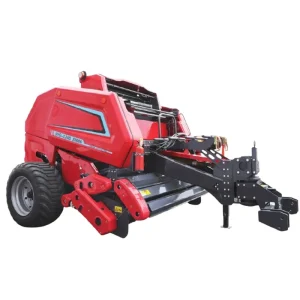
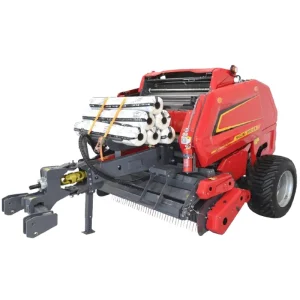
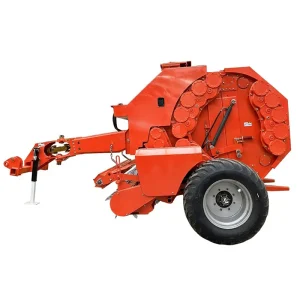
9YG-1.0
Round Baler
Patented axial-flow intake. 65 HP minimum. 5,820 lb. For farms where the tractor is compact but the baling window is not.
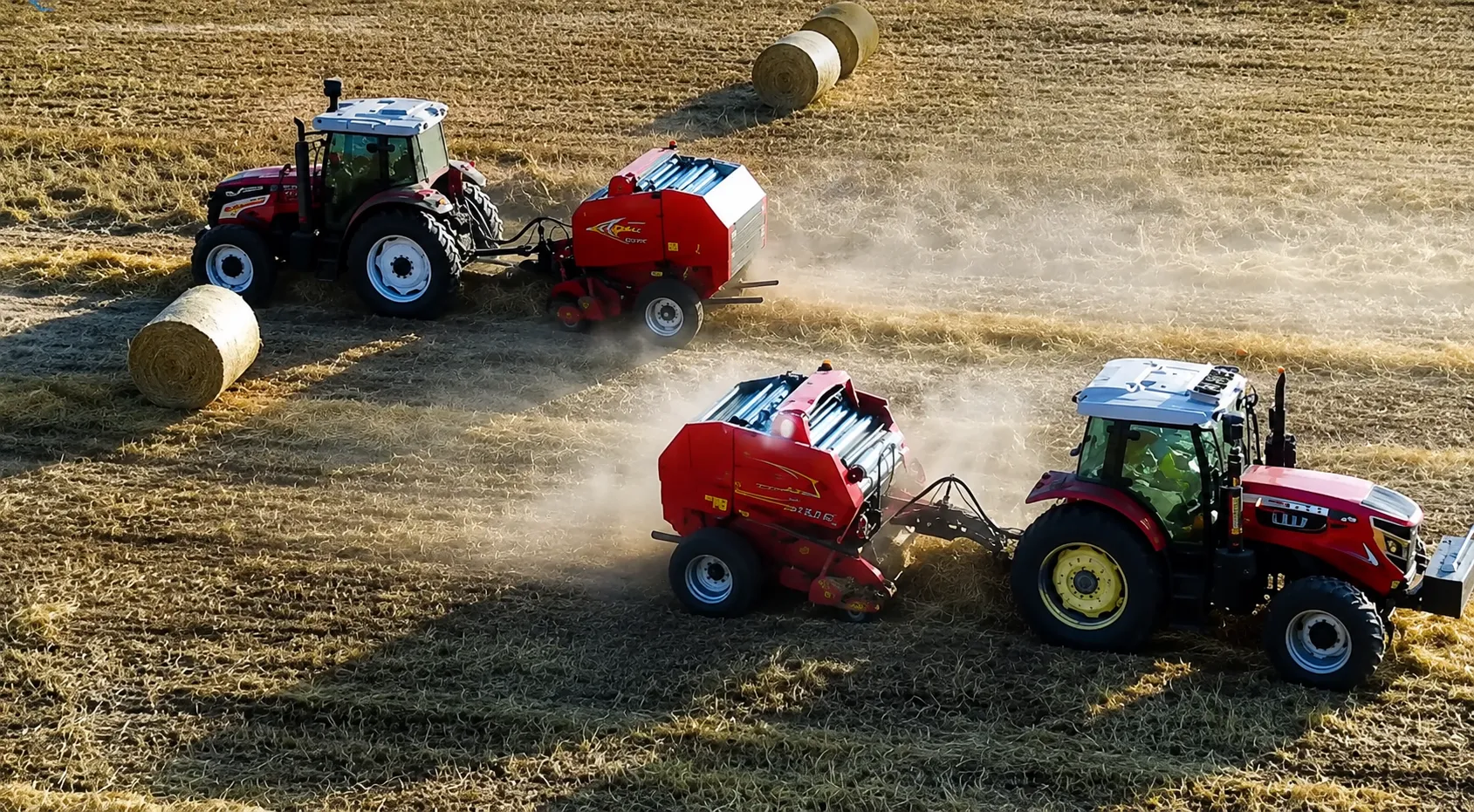
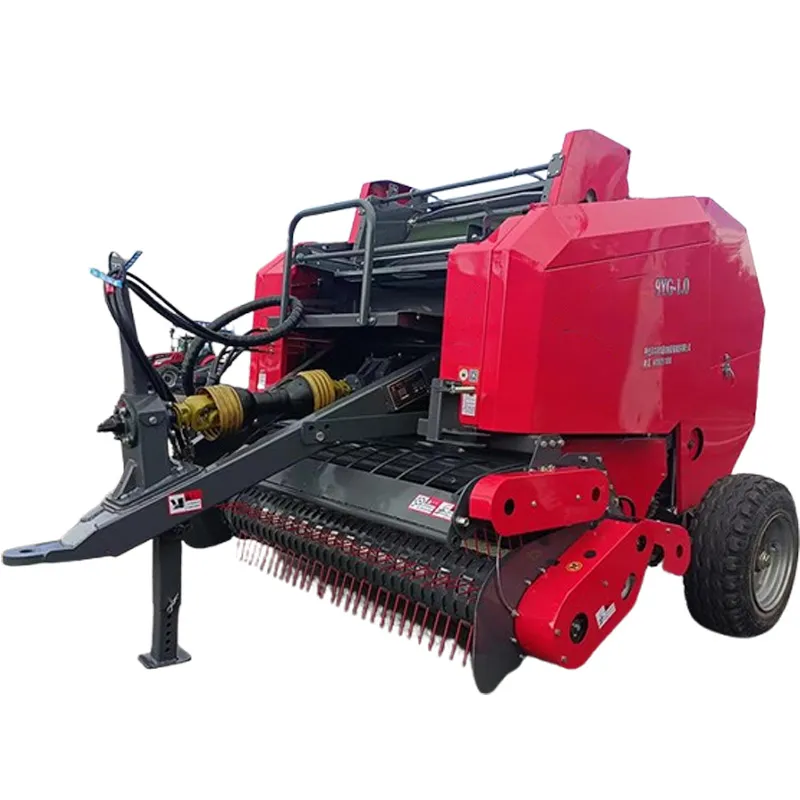
Compact round balers typically come with a compromise: lower productivity, more blockage risk in heavy material, or a fixed cam-track pickup that consumes power and jams in variable-quality windrows. The 9YG-1.0 was developed to remove those constraints from the compact class. Its axial-flow semi-force-feed intake — a patented mechanism developed by Brazil Ever-Power Farm Balers Co., Ltd — eliminates the cam-track and guard ring assembly that conventional pickups use to guide material into the chamber. The result is a freer, higher-flow crop path that the manufacturer reports nearly doubles effective throughput compared to traditional designs, while reducing blockage frequency in the dense and irregular windrows common in corn stalk, rice, and soybean straw operations.
The bale format is compact: Φ1,100 × 1,000 mm — approximately 43 × 39 inches. Bales in this size range weigh 250–450 lb in typical dry hay or straw conditions, manageable with a small loader or even by hand-rolling on flat ground. For operations where the downstream handling equipment — feeders, storage, transport vehicles — is sized for smaller bales, or where the loading capacity of the available tractor limits how large a machine can be pulled, the 9YG-1.0 delivers 40–100 bales per hour in a package that matches those constraints.
The machine is designed for multi-crop versatility: corn stalks, rice straw, wheat straw, soybean straw, and pasture hay all process through the same axial-flow intake without pickup system changes. For the full range, see Brazil Ever-Power Farm Balers’ product catalog.
Patented Technology
Axial-Flow Semi-Force-Feed Intake — Camless, Ringless
Conventional round baler pickups use a cam-track assembly — a shaped guide rail that controls how tines sweep and release material into the chamber. This mechanism adds mechanical complexity, creates friction and drag under load, and is the most common single point of blockage failure when material flow is uneven or crop density spikes suddenly.
The 9YG-1.0’s axial-flow intake removes the cam-track entirely. Material flows through an open, unobstructed path at higher volume and with less resistance. The manufacturer’s internal testing reported throughput increases approaching 80–100% compared to the cam-track design, with significantly reduced blockage rates in heavy corn stalk or tangled soybean straw conditions. This patent is held exclusively by Brazil Ever-Power Farm Balers Co., Ltd and is not licensed to third-party manufacturers.

Utility patent issued to Hulunbuir Jiujia Machinery Equipment Manufacturing Co., Ltd — parent of Brazil Ever-Power Farm Balers Co., Ltd
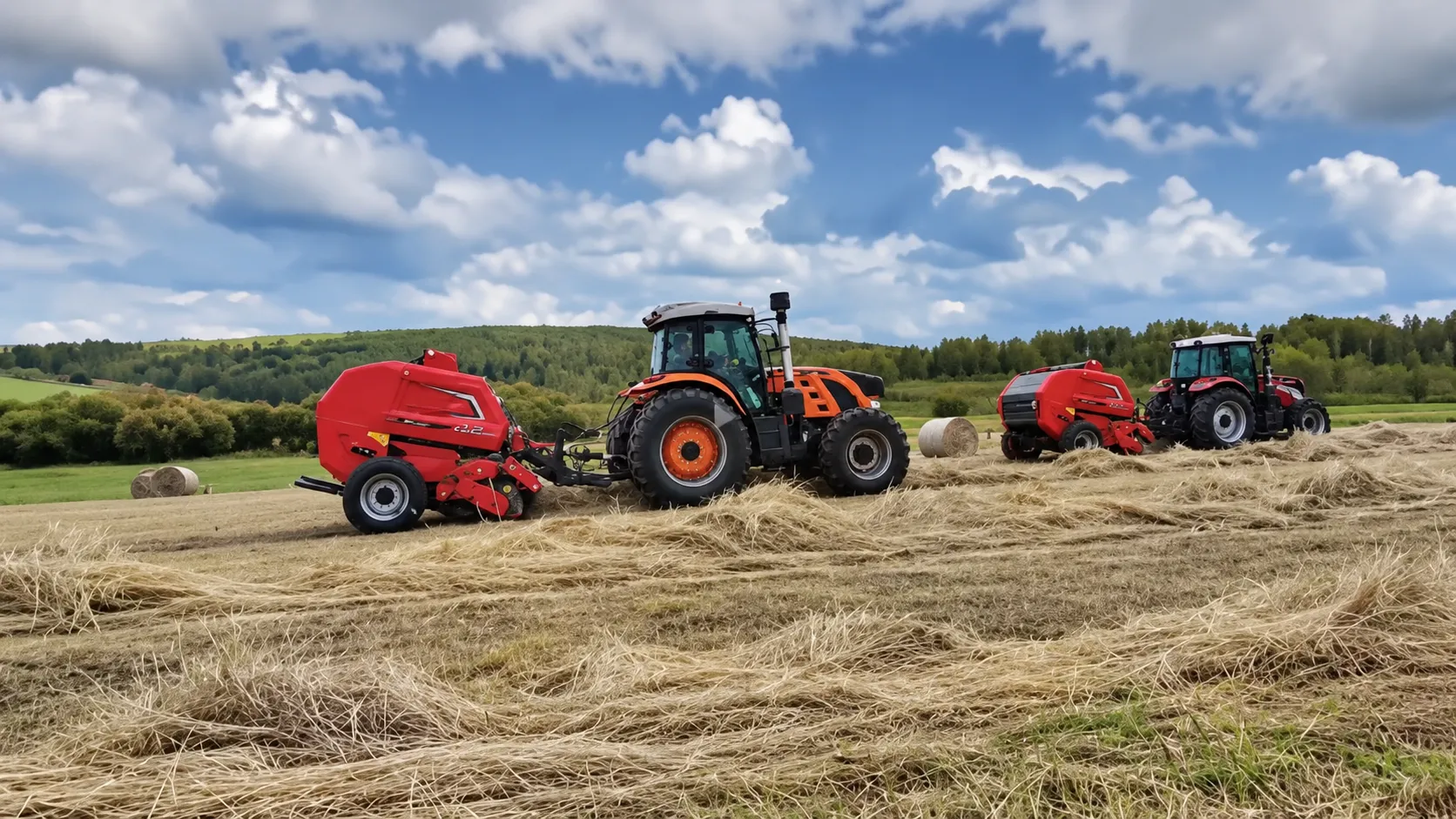
Technical Specifications
| # | Parameter | Unit | Value |
|---|---|---|---|
| 1 | Model Name | — | 9YG-1.0 Round Baler |
| 2 | Hitch Type | — | Towed (Drawbar) |
| 3 | Pickup Width | mm / in | 1,900 mm (74.8 in) |
| 4 | Pickup Type | — | Spring Tooth |
| 5 | Feed System | — | Axial-Flow Semi-Force-Feed (Patented — Camless, Ringless) |
| 6 | Chamber Type | — | Fixed-Chamber Roller |
| 7 | Chamber Width | mm / in | 1,000 mm (39.4 in) |
| 8 | Chamber Diameter | mm / in | Φ 1,100 mm (43.3 in) |
| 9 | Number of Rollers | pcs | 16 |
| 10 | Roller Diameter | mm | 222 mm (8.7 in) |
| 11 | Wrapping System | — | Net Wrap (Standard) |
| 12 | Tractor Power Required | kW / HP | 48–80 kW (65–107 HP) |
| 13 | Machine Weight | kg / lb | 2,640 kg (5,820 lb) |
| 14 | PTO Speed | RPM | 720 |
| 15 | Overall Dimensions (L×W×H) | mm | 3,750 × 2,300 × 2,020 (working) |
| 16 | Bale Density Control | — | Electronic Sensor |
| 17 | Bale Size (Dia. × Width) | mm / in | Φ 1,100 × 1,000 mm (43 × 39 in) |
| 18 | Bale Density | kg/m³ | 115–200 |
| 19 | Productivity | bales/hr | 40–100 |
| 20 | Track Width | mm | 2,045 |
| 21 | Operating Speed | km/h / mph | 5–20 km/h (3–12 mph) |
| 22 | Net Wrap Specification | — | 2,000 × 1.0 m per bale |
What the 9YG-1.0 Delivers
Patented Camless Intake — ~2× Throughput
The axial-flow semi-force-feed intake on the 9YG-1.0 shares its engineering concept with the intake systems used across the S9000 series — the same parent company, the same R&D center, the same patent. In the compact 9YG-1.0, removing the cam-track is especially impactful because compact balers typically have smaller intake apertures that are more sensitive to blockage. The camless design keeps that aperture clear regardless of material density spikes, making the 9YG-1.0 more reliable in mixed-quality crop conditions than most machines at its price point.
65 HP Minimum — Broad Tractor Compatibility
The 9YG-1.0’s minimum HP threshold — 65 HP — is the lowest in the farmbalers.com range by a significant margin. The next model up, the 9YG-1.0C, requires 95 HP; the 9YG-1.25 series starts at 100 HP. This means the 9YG-1.0 is compatible with small utility tractors, specialty crop tractors, and older equipment in the 65–80 HP range that could not practically pull any other model in the lineup. The reduced power demand also translates to lower fuel cost per bale on compatible tractors that would be operating at or near capacity with a larger machine.
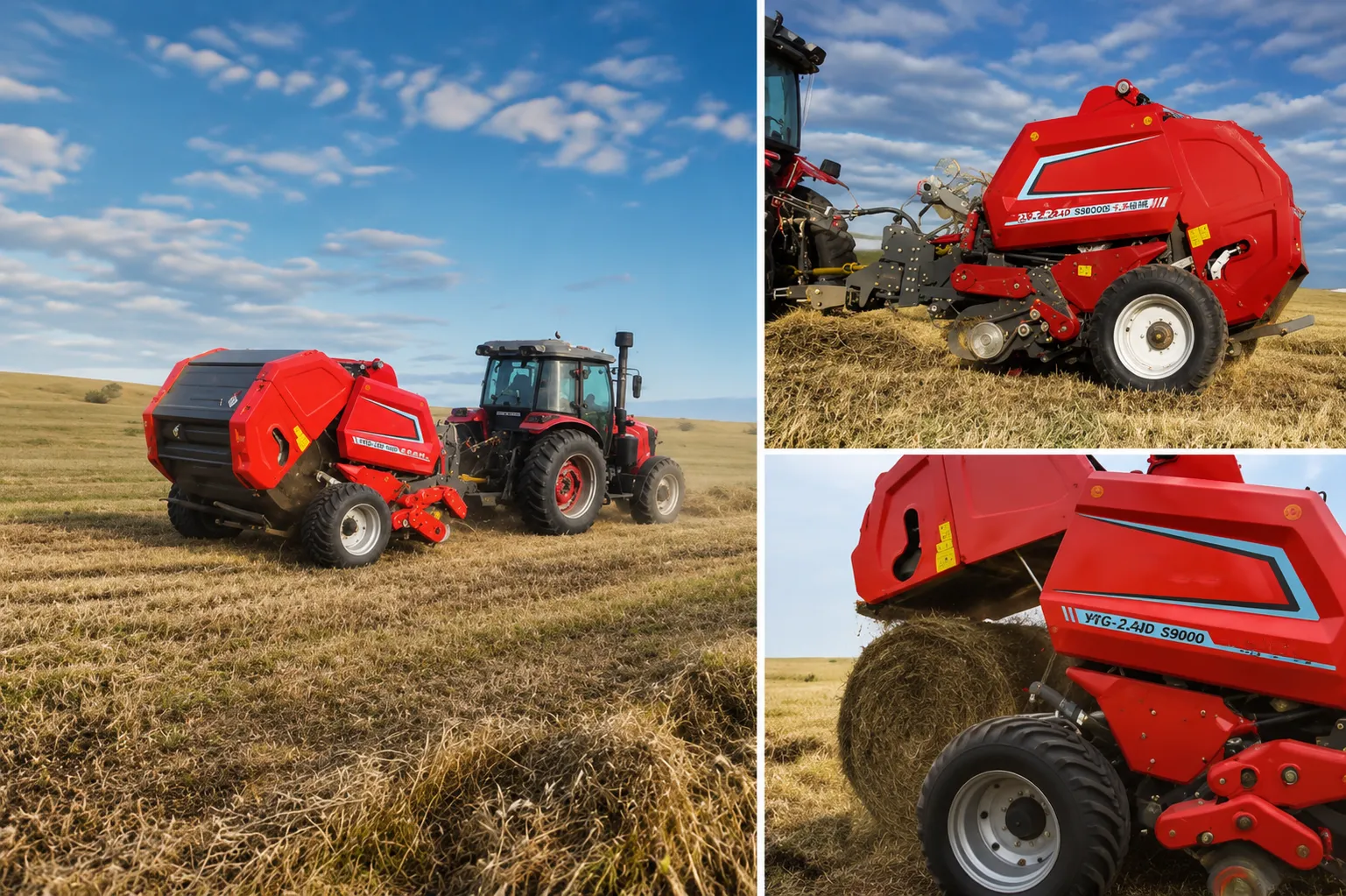
Corn · Rice · Wheat · Soybean · Pasture
The camless intake’s primary operational advantage beyond throughput is multi-crop flexibility. Conventional cam-track systems are calibrated for a specific material flow rate — change the crop type significantly and the cam-track’s release timing becomes either too aggressive (causing overflow) or too slow (causing a packed intake). The 9YG-1.0’s open-path intake adjusts passively to different material densities and stem characteristics, processing corn stalks in the morning and rice straw in the afternoon without mechanical adjustment. This versatility suits small diversified farms where a single machine must handle several crop residue types across the season.
5,820 lb — Lightest in the Range
At 2,640 kg (5,820 lb), the 9YG-1.0 is the lightest machine in the farmbalers.com range by 1,230 lb over the next lightest (9YG-1.0C at 7,050 lb). Lower machine weight produces less soil compaction on post-harvest fields, draws less fuel moving the implement mass during transport, and imposes lower dynamic load on the tractor’s drawbar and hitch system. The compact bales themselves — Φ1,100 × 1,000 mm, 250–450 lb in typical straw and hay — are the lightest individual bale in the range, movable with small loaders or by hand on firm ground.
Suitable Crops & Conditions
Corn stalks (raked to windrow), rice straw, wheat straw, soybean straw, oat and barley straw. The camless intake handles the variable density and stem diameter characteristics of mixed residue types without mechanical adjustment between crops.
Mixed pasture grasses, brome, fescue, orchardgrass, and bermudagrass in windrows. The spring-tooth pickup collects gently — suitable for dry material where leaf shatter at the pickup reduces forage feeding value. 720 RPM PTO provides consistent chamber speed across hay moisture ranges.
Cereal rye, hairy vetch, triticale terminations in windrows. The camless intake’s higher volumetric capacity handles dense, tangled cover crop mats more smoothly than conventional cam-track pickups, which are prone to packing and jamming in thick rye terminations.
Any tractor providing 65–107 HP at the rear 720 RPM PTO. Compact utility tractors, older mid-range equipment, and specialty crop tractors in this HP range connect directly without adapter. 720 RPM is required — the 9YG-1.0 does not accept 540 or 1000 RPM input.
Small livestock feeding (43 × 39 in format fits small round bale feeders), bedding, biomass, and on-farm storage. Bale weight 250–450 lb in typical straw and pasture hay conditions — manageable with compact loaders or bale spikes rated at 500 lb or above.
Flat to moderately rolling. Compact footprint (3,750 × 2,300 mm working) suits narrow field lanes and tighter headlands than larger machines. For regular side slopes above 10–12°, see the S9000 Superior.
Field Operation
Attach drawbar at 720 RPM PTO. Set pickup gauge wheel height — lower for thin windrows, higher for fluffy straw. Load 1.0 m net wrap roll and thread through the guide as per the operator manual. The narrower net roll (1.0 m vs 1.25–1.4 m on larger models) is the most economical option in the range and widely available at agricultural supply stores.
Advance at 5–12 mph in normal hay and straw windrows. The camless intake handles material flow variations passively — moderate speed changes do not require stopping to clear an intake pack as often as cam-track machines. The 16-roller chamber fills to Φ1,100 mm; the sensor triggers net wrap automatically at the preset density setpoint.
Slow to near-idle during the net wrap cycle. Net applies across the 1,000 mm bale face, cuts, and the gate opens automatically. The compact bale — 43 × 39 inches — rolls out and stops on the stubble. Gate closes automatically. Typical cycle time net-wrap-to-gate-closed: 15–20 seconds. Resume forward travel after gate close signal.
For raked corn stalk windrows, reduce forward speed to 4–7 mph compared to dry hay. The camless intake handles denser material well, but corn stalks have higher stem inertia than grass and should not be overfed into the pickup at high speed. The sensor adjusts density trigger timing based on chamber pressure — allow the system to respond before forcing more material in.
Rice straw is among the most challenging materials for conventional intakes — it is tangled, high-volume, and tends to form dense mats in the windrow. The 9YG-1.0’s open-path intake passes rice straw with significantly fewer jams than cam-track alternatives. Run at 5–8 mph and confirm the pickup gauge wheels are set high enough not to collect soil with the root mat, which is a common issue in paddy field straw baling.
The 9YG-1.0’s compact working width (2,300 mm) allows tighter headland turns than the wider machines in the range. Disengage PTO before making sharp turns if the PTO shaft articulates beyond about 35°. On small or irregular fields where frequent turns are required, the 9YG-1.0’s compact footprint is an advantage over the S9000 or 9YH-1400 series.
Maintenance
- Grease all pickup tine pivots, roller shaft ends, and chain idler bearings
- Check 1.0 m net wrap roll load and brake tension — uneven brake produces thin-edge wrap on the compact bale face
- Verify PTO shaft guard is intact; check telescoping section for free movement
- Confirm the camless intake throat is clear of any accumulated fibre — a brief visual check before starting; the open path design reduces accumulation but doesn’t eliminate it entirely
- Adjust drive chain tension — check mid-span sag, maximum 15–20 mm
- Inspect pickup tines for bending or length reduction; replace tines showing cracks at the base
- Check roller bearing condition — roughness or operating heat are early-warning signs
- Inspect the open intake throat for fibre accumulation at the transition between the pickup sweep and the chamber entry — compact machines accumulate faster here than wider-throat designs
- Drain and replace gearbox oil — check operator manual for grade
- Replace pickup tine set if overall wear exceeds 15% by length count — small machines have smaller tine sweep radius and tines wear proportionally faster
- Inspect all 16 roller bearings; replace any with play
- Clean machine, apply anti-corrosion spray to unpainted surfaces, release chain tension, remove 1.0 m net wrap roll for dry storage
Operator Reviews
Southern Ohio — Diversified Small Farm, 80 HP tractor, corn + hay + cover crops
★★★★★
We have an 80 HP tractor and run a diversified small farm — corn, hay, and a cover crop rotation. Every other baler we looked at needed 100 HP or more. The 9YG-1.0 is the only one in our price range rated for our tractor. It’s been working well across all three crop types: first-cut mixed grass hay in spring, corn stalk windrows in fall, and cereal rye cover crop in between. The patented intake system is genuinely better than the budget balers we tested before purchasing — we had significant blockage problems with those machines in our rye termination, and the 9YG-1.0 has not jammed once in the same conditions across 1,800 bales. Bale quality is consistent. The compact bale size suits our small round bale feeders. We’re very satisfied.
Northern California — Rice Straw Baling, 75 HP tractor, 400 acres
★★★★☆
Rice straw has been a problem material for every baler I’ve run. It mats in the windrow, it’s dense in patches, and conventional cam-track pickups jam constantly. The 9YG-1.0’s intake has handled it significantly better than the two machines I used before — I think I’ve had maybe three stoppages in 2,200 bales this season, compared to a dozen or more per day with the previous machine. That said, I run at about 5–6 mph in rice straw and I do need to adjust forward speed carefully in patches where the mat is particularly dense. The bale quality is good enough for my market (mushroom compost substrate). Four stars because the gauge wheel setting needs more frequent adjustment in paddy field conditions where the ground surface is uneven — the pickup occasionally digs in on soft spots and picks up soil with the straw. Not unique to this machine, but worth mentioning.
North Carolina — Goat Farm, 70 HP tractor, cereal rye cover crop baling
★★★★★
I needed a baler for our goat hay and cereal rye straw — the 70 HP tractor we have isn’t going to pull anything larger. Most machines I looked at started at 100 HP. The 9YG-1.0 has been an excellent fit. The compact bales are actually better for our setup — we unload by hand from the trailer into our barn, and the 39-inch width is manageable without heavy equipment. In cereal rye, the intake hasn’t jammed at all despite the rye being fairly thick this year; I think the cam-free design makes a real difference. Our goats are eating the hay readily and the bale quality looks good. Fast response from the sales team on a question about net wrap sizing. Would recommend to any small farm on a compact tractor.
Eastern Kansas — Wheat Straw & Hay, 90 HP tractor, 350 acres
★★★★☆
I bought the 9YG-1.0 to work with my 90 HP tractor and it’s been a good fit for my scale of operation — 350 acres of wheat and hay. Wheat straw baling has been clean; the intake handles the large combine windrows well at around 65–70 bales per hour, which is better than I expected from a machine at this weight. Hay has also been consistent. I’m at four stars rather than five because I’ve noticed the smaller bale format creates more loading and transport cycles for my straw market customer — he’d prefer larger bales. The machine works as described; it’s just that at 350 acres of straw, the smaller bale format adds some handling overhead. Anyone above 400 acres probably wants to consider the next model up in terms of bale size. Below 350 acres, the 9YG-1.0 is well-suited.
Central Missouri — Hay Operation, 100 HP tractor, 750 acres
★★★☆☆
The 9YG-1.0 bales well and the intake genuinely works better than competitors at this price point. I have no complaints about the machine’s quality. But at 750 acres of hay, the smaller bale format and lower chamber volume create a throughput ceiling that costs me time and handling cycles compared to what a 9YG-1.25 would deliver. The 9YG-1.0 is rated to 40–100 bales per hour, but the bales are smaller — I’m producing 70 bales per hour versus what might be 55–60 from a 1.25 series, but each of my bales holds 15–20% less hay. Net tons baled per hour is therefore lower than a 1.25 machine at the same bale count. Three stars is not a complaint about build quality — the machine is solid and the intake is good. It’s an honest signal that the 9YG-1.0 has a volume ceiling and above 400–500 acres of hay, stepping up to the 1.25 series makes operational sense.
Frequently Asked Questions
What does “camless, ringless” mean in practical terms?
In a conventional pickup, a cam-track is a shaped guide rail that controls how the spring tines rotate and release material as they sweep through the pickup arc. A protective ring or guard surrounds the cam to prevent debris ingestion. Together these components add mechanical complexity and create a choke point where material can pack and jam — especially with irregular, tangled, or high-volume crops. The camless, ringless design removes both components. Material flows through a wider, unobstructed path at higher volumetric rate. There is no cam-track to jam and no guard ring to pack against. The trade-off is that the open design is less selective about what enters the chamber — operators should avoid running over large stones or debris that a cam-track guard ring might have deflected.
Can the 9YG-1.0 run on a 65 HP tractor in all conditions?
The 65 HP minimum rating applies to normal dry hay and straw at standard windrow densities and moderate forward speeds. In demanding conditions — very dense windrows, high-moisture material, or thick cover crop terminations — a 65 HP tractor will be operating near its PTO output limit and may slow or stall in heavy patches. Operators with 65–75 HP tractors should reduce forward speed in heavy material to stay within the tractor’s PTO capacity. A 75–90 HP tractor will handle the machine more comfortably across the full range of crop conditions. The 65 HP rating is a genuine minimum for appropriate conditions, not a comfortable operating target in demanding material.
Is the 9YG-1.0 suited for soybean straw baling?
Yes, with appropriate field conditions. Soybean straw baling works best when the material has been windrowed by a rake or windrow merger after combine harvest. Soybean straw is notoriously fragile — the stems shatter easily and leaf material crumbles — so the spring-tooth pickup should be set with generous ground clearance (avoid tine-to-ground contact) to minimize soil pickup. The camless intake is well-suited to soybean straw’s variable density and tendency to clump. Run at moderate forward speed and avoid running in wet conditions where soybean straw compacts heavily on the soil surface.
Does the 9YG-1.0 accept 540 RPM PTO?
No. The 9YG-1.0 requires 720 RPM PTO input. It does not accept 540 or 1000 RPM. Tractors providing only 540 RPM will not drive the machine at correct operating speed. If your tractor provides only 540 RPM, the 9YH-1.25A6 (which accepts 540, 720, and 1000 RPM) is the appropriate model.
What is the bale weight in practical terms?
The Φ1,100 × 1,000 mm bale produces approximately: dry grass hay (12% moisture) 250–380 lb; wheat straw (10%) 200–320 lb; corn stalk windrow (15%) 300–450 lb; rice straw (12%) 220–350 lb. These are the lightest bales in the farmbalers.com range by a significant margin, which is a practical advantage for operations handling bales without heavy loaders — a standard compact tractor front loader rated at 1,500 lb can typically manage these bales comfortably.
When should I step up to the 9YG-1.25 instead?
Consider the 9YG-1.25 when: your tractor provides 100 HP or more and you want to maximise tons baled per hour; you need a 51 × 49-inch bale format for equipment compatibility (feeders, wrappers, export); your annual volume exceeds approximately 400–500 acres; or your primary market requires larger bales. The 9YG-1.0’s advantages — lower HP minimum, lower machine weight, lighter per-bale handling — pay off most clearly at smaller operation scales with compact tractor fleets.
How do I order parts and what is the lead time?
Parts are ordered through Brazil Ever-Power Farm Balers Co., Ltd’s spare parts program. Standard in-stock items — pickup tines, drive chain, roller bearings, net wrap components — ship to US customers with an estimated 10–18 business day lead time. Pre-season: order a spare parts kit including one full pickup tine set, drive chain length, two roller bearings, and net wrap brake pads before each baling season. The 1.0 m net wrap roll is the smallest standard roll size and is widely available from US agricultural suppliers, so that consumable can be sourced locally. Additional product documentation at Brazil Ever-Power Farm Balers’ product catalog.
Manufacturer
Brazil Ever-Power Farm Balers Co., Ltd
National high-technology enterprise. 32,000 m² in-house manufacturing facility. Two assembly lines at 2,000 units/year capacity each. Close to 100 utility patents including the axial-flow intake system used in the 9YG-1.0. All fabrication in-house — CNC laser cutting, robotic welding, electrostatic coating. ISO 9001, Two-Informatization Integration Level A, AAA Credit Enterprise, National High-Technology Enterprise. Independent import and export rights. Markets: US, Mongolia, Russia, Belarus, Kazakhstan.
Full product catalog at Brazil Ever-Power Farm Balers’ product catalog.
Explore the Full Range
If the 9YG-1.0 isn’t the right fit for your operation, these models may be:
← scroll to see more →