Leírás
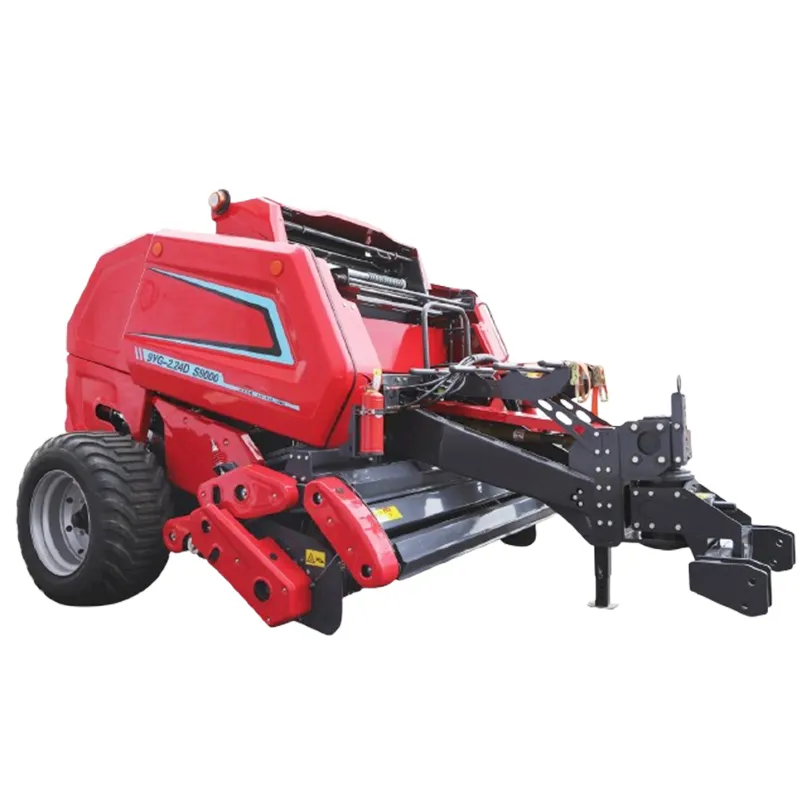
At a Glance
720 RPM PTO · Net Wrap Standard · Electronic Density Sensor · Towed Drawbar · Machine Weight: 10,076 lb
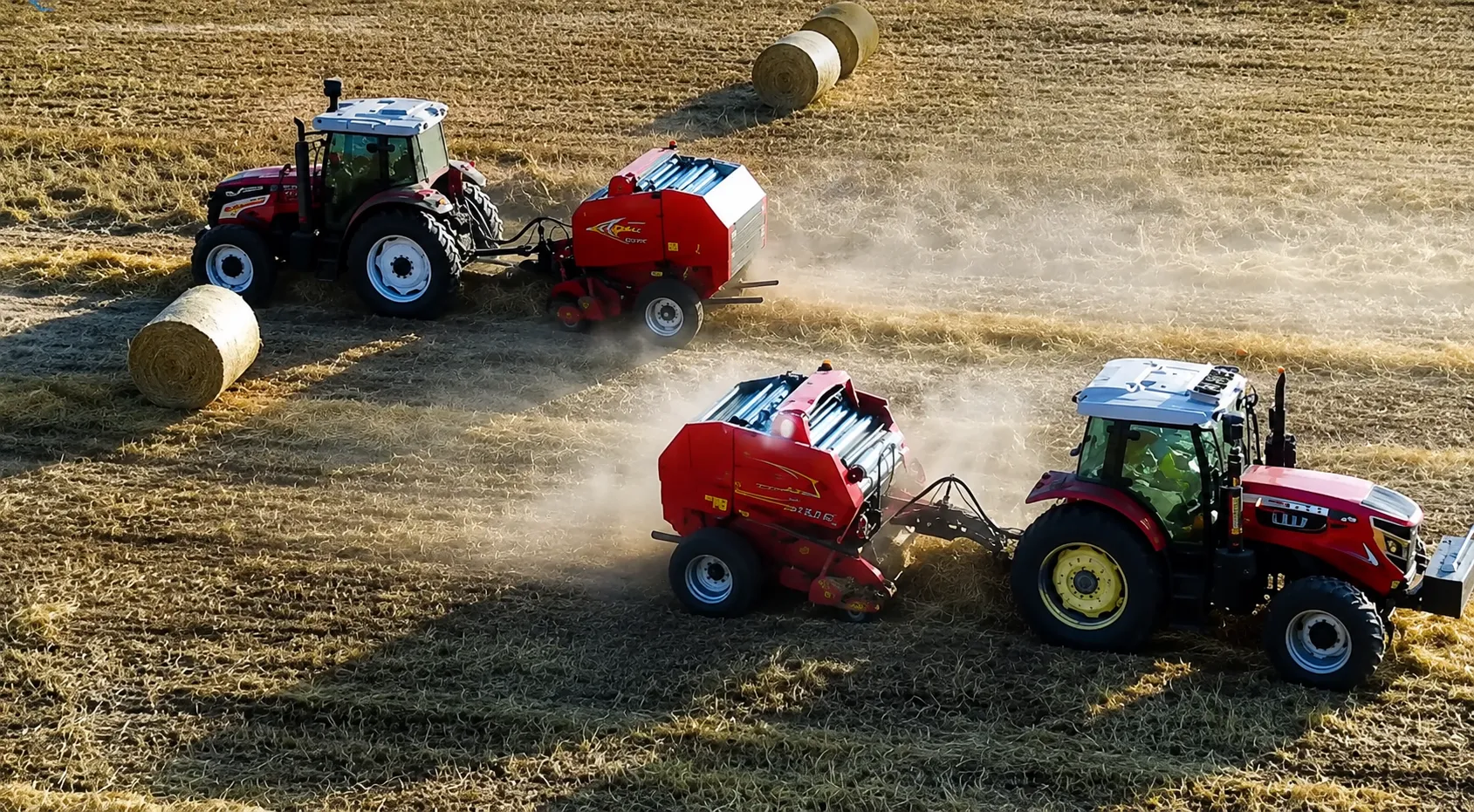
A baler that can only run level does half the job in hill country. When the ground tilts and the tractor drifts uphill relative to the windrow, a fixed-hitch baler’s pickup also tilts — one end rises above the crop and misses material while the other end digs in and gathers soil. The operator either slows to a crawl to minimize the alignment error, overlaps passes to compensate for missed crop, or accepts poor bale quality. None of those options are acceptable in a high-volume operation.
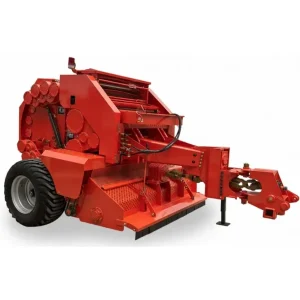
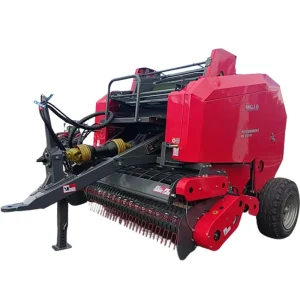
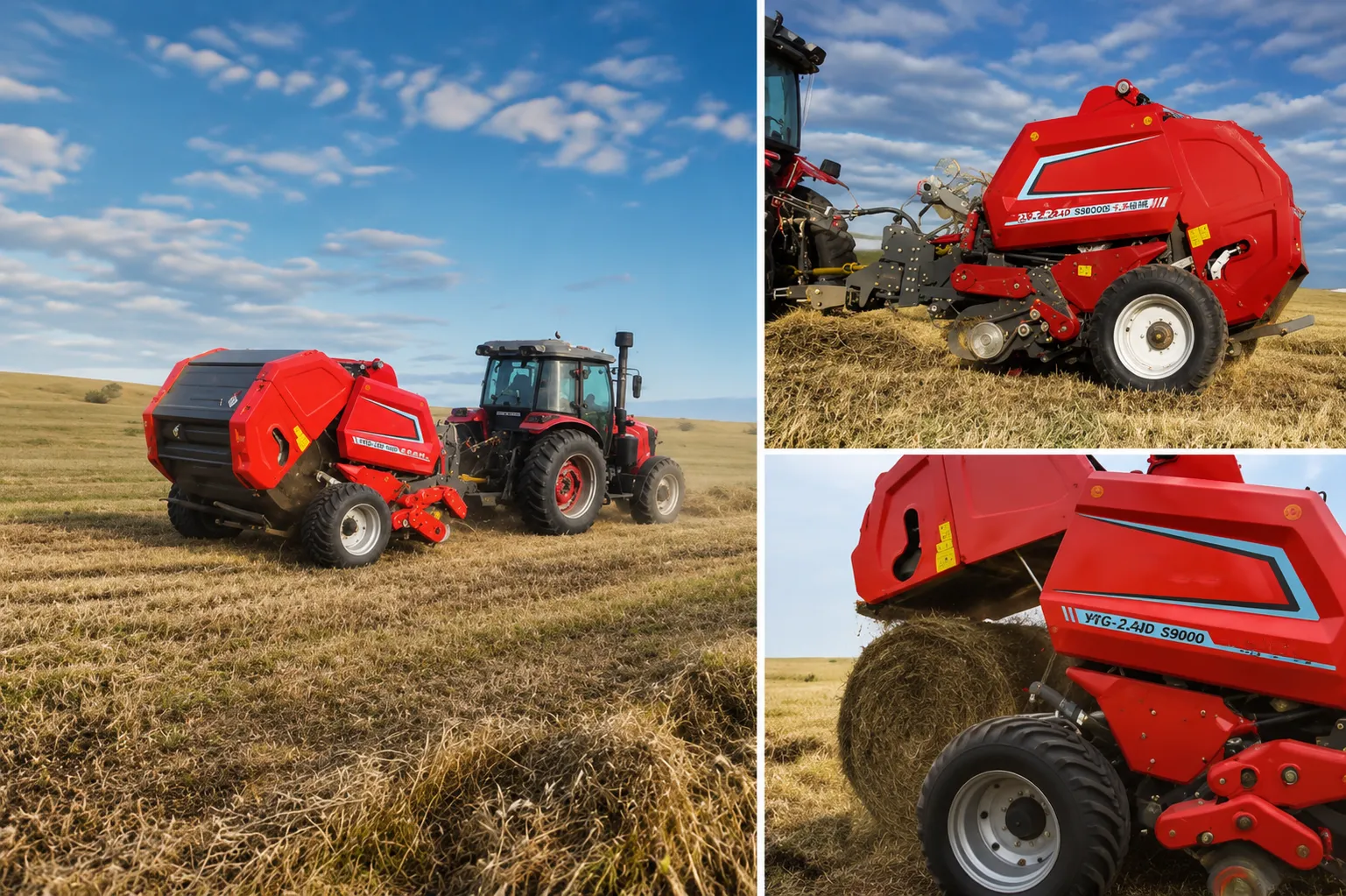
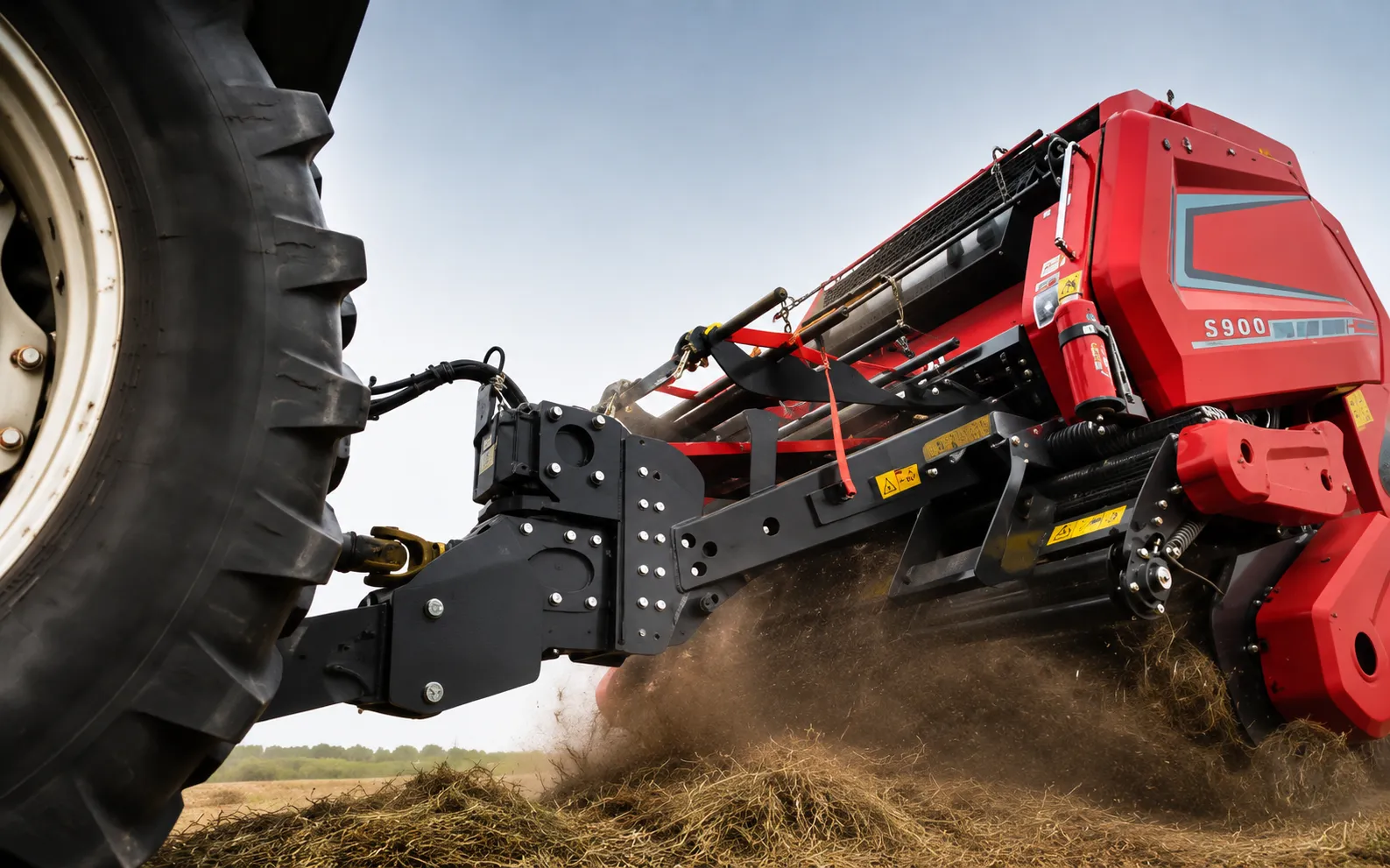
The S9000 Superior’s dual-gearbox hitch solves this at the mechanical level. The hitch assembly is built around two gearboxes mounted on a shared carrier frame. Because the gearboxes drive the PTO input from within the carrier rather than through a rigid drawbar, the carrier itself can rotate in two planes simultaneously — up to 100° of horizontal swing left or right, and up to 30° of lateral tilt in either direction. The tractor can lean on a side slope, turn at a headland, or navigate a contour strip while the baler’s pickup tracks the windrow independently. No power interruption, no manual adjustment, no need to straighten up before engaging the PTO.
Paired with dual 20A heavy-duty rear chamber chains rated at 500–1,000 kgf compression force and a maximum hitch torque rating of 1,000 N·m, the Superior also handles the additional mechanical stress that comes with hillside operation — where gravity works against both the machine’s weight balance and the uniformity of crop feeding into the chamber. The result is the same 40–100 bale-per-hour output as the other S9000 variants, sustained consistently on ground that would force significant concessions from a fixed-hitch machine. For the full range of S9000 variants and additional round baler models, see Brazil Ever-Power Farm Balers’ product catalog.
Technical Specifications
| # | Parameter | Unit | Érték |
|---|---|---|---|
| 1 | Model Name | — | 9YG-2.24D (S9000 Superior) |
| 2 | Hitch Type | — | Towed (Drawbar) |
| 3 | Hitch Horizontal Swing | ° | 100° (±50° each side) |
| 4 | Hitch Lateral Tilt | ° | 30° max (either direction) |
| 5 | Max Hitch Torque | N·m | 1,000 |
| 6 | Felvételi szélesség | mm / in | 2,240 mm (88.2 in) |
| 7 | Pickup Type | — | Spring Tooth |
| 8 | Feed System | — | Tooth Bar + Roller (Axial-Flow, Patented) |
| 9 | Chamber Type | — | Fixed-Chamber Roller |
| 10 | Chamber Width | mm / in | 1,400 mm (55.1 in) |
| 11 | Chamber Diameter | mm / in | Φ 1,200 mm (47.2 in) |
| 12 | Number of Rollers | pcs | 18 |
| 13 | Roller Diameter | mm | Φ 222 mm (8.7 in) |
| 14 | Rear Chamber Drive | — | Dual 20A Heavy-Duty Chain, Both Sides |
| 15 | Compression Force | kgf | 500–1,000 |
| 16 | Wrapping System | — | Net Wrap (Standard) |
| 17 | Tractor Power Required | kW / HP | 55–100 kW (74–134 HP) |
| 18 | Machine Weight | kg / lb | 4,570 kg (10,076 lb) |
| 19 | PTO Speed | RPM | 720 |
| 20 | Overall Dimensions (L×W×H) | mm | 4,600 × 3,010 × 2,370 (working) |
| 21 | Bale Density Control | — | Electronic Sensor |
| 22 | Bale Size (Dia. × Width) | mm | Φ 1,300 × 1,400 |
| 23 | Bálasűrűség | kg/m³ | 100–200 |
| 24 | Productivity | bales/hr | 40–100 |
| 25 | Track Width | mm | 2,600 |
| 26 | Operating Speed | km/h / mph | 5–35 km/h (3–22 mph) |
| 27 | Net Wrap Specification | — | 2,000 × 1.4 m per bale |
The Superior’s Two Key Upgrades
What it adds over the standard S9000 and S9000 Classic
Dual-Gearbox Adjustable Hitch — 100° Swing / 30° Tilt / 1,000 N·m
The defining feature of the Superior — not available on either other S9000 variant
The hitch assembly on most towed round balers is a rigid or semi-rigid drawbar — it allows horizontal articulation for turns, but does not permit the baler to tilt laterally relative to the tractor. This works fine on flat or gently rolling ground, but on a side slope the tractor and baler tilt together, and the pickup tilts with them. At a 15° slope — common in Appalachian hay fields, Pacific Northwest grass seed country, or mid-Atlantic pasture — a fixed-hitch baler’s pickup can be running several inches out of level. The uphill end misses crop, the downhill end digs and gathers soil, and bale shape degrades because the material enters the chamber unevenly.
The Superior’s dual-gearbox hitch solves this mechanically. Two gearboxes are mounted on a shared carrier frame. The carrier connects to the tractor drawbar pin through a joint that allows lateral rotation up to 30° in either direction — independent of what the tractor’s body is doing. When the tractor is tilted 15° on a side slope, the operator can compensate by dialing in 15° of counter-tilt on the hitch, keeping the pickup running level relative to the ground surface. The same carrier also provides 100° of horizontal swing — enough for full headland turns in tight fields without cutting PTO power.
The gearbox-based design also improves power transmission efficiency compared to shaft-only arrangements at steep angles. Because the gearboxes redirect drive inside the carrier, the PTO shaft input angle is managed internally — the external shaft sees a gentler effective operating angle even when the carrier is tilted or swung significantly. The hitch is rated to 1,000 N·m, which covers the full torque demands of the 18-roller compression chamber and dual 20A rear drive under heavy-crop loading.
Who this matters for
Operations in hilly terrain — Appalachia, Ozarks, Pacific Northwest, upper Midwest — where contoured fields, side slopes, and irregular ground profiles are routine rather than exceptional. Also valuable for custom operators who move between many farms and encounter varying terrain without knowing in advance what grade they’ll be working.
Dual 20A Heavy-Duty Rear Chamber Chain — 500–1,000 kgf
Higher compression force; symmetrical load distribution at elevated torque ratings
The 20A roller chain designation refers to the chain’s pitch and load rating — 20A chains are rated for higher tensile and fatigue loads than the lighter chain grades used in standard round baler rear drives. Running a pair of them, one on each side of the chamber, achieves two things. First, compression force increases to a rated 500–1,000 kgf — the higher end of the range for heavy, dense material like wet alfalfa or corn stover — which directly translates to tighter, heavier bales. Second, symmetric dual-side drive means both sides of the 1,400 mm chamber receive equal input torque simultaneously, eliminating the slight roller speed differential that single-side drive systems produce and that can cause minor density variation across the bale’s width.
The 20A specification also has a service life advantage. Chain wear rate is closely related to the ratio of working load to rated load capacity — a chain operating at 60% of its rated capacity wears measurably slower than one at 85%. By using a higher-rated chain across both sides, each chain’s working load as a fraction of its rated capacity is lower, extending inspection and replacement intervals in typical operating conditions.
Note on bale weight
Higher compression force does not automatically produce heavier bales — bale weight is primarily a function of crop density and chamber volume, which are the same across all S9000 variants. What higher compression force produces is more consistent bale core compaction, which improves bale shape retention after ejection and reduces the “mushrooming” at bale ends that affects stacking stability on flatbed transport.
Intellectual Property
Patented Intake System — Camless, Ringless Architecture
The axial-flow semi-force-feed intake mechanism running across the full S9000 series — including the Superior — is a proprietary design developed in Brazil Ever-Power Farm Balers Co., Ltd’s autonomous R&D center and protected under an independent utility patent. The mechanism’s camless, ringless architecture increases volumetric crop flow compared to conventional cam-track designs, reduces blockage frequency in heavy or mixed-quality windrows, and lowers the power demand at the intake stage.
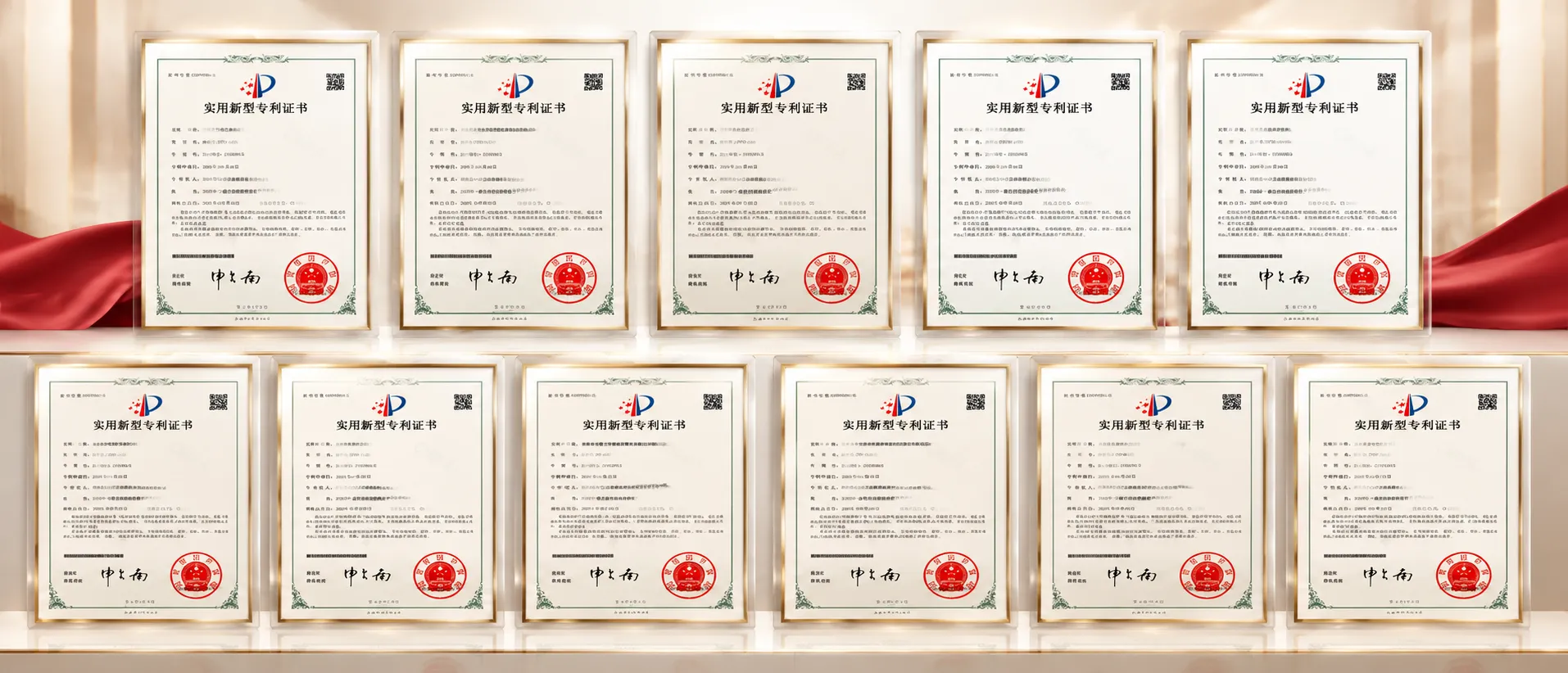
The company holds close to 100 utility patents across its product range. All units are manufactured in-house at a 32,000 m² facility using CNC laser cutting, robotic welding, and electrostatic coating — no third-party fabrication of primary structural or mechanical components.
Where the Superior Earns Its Price
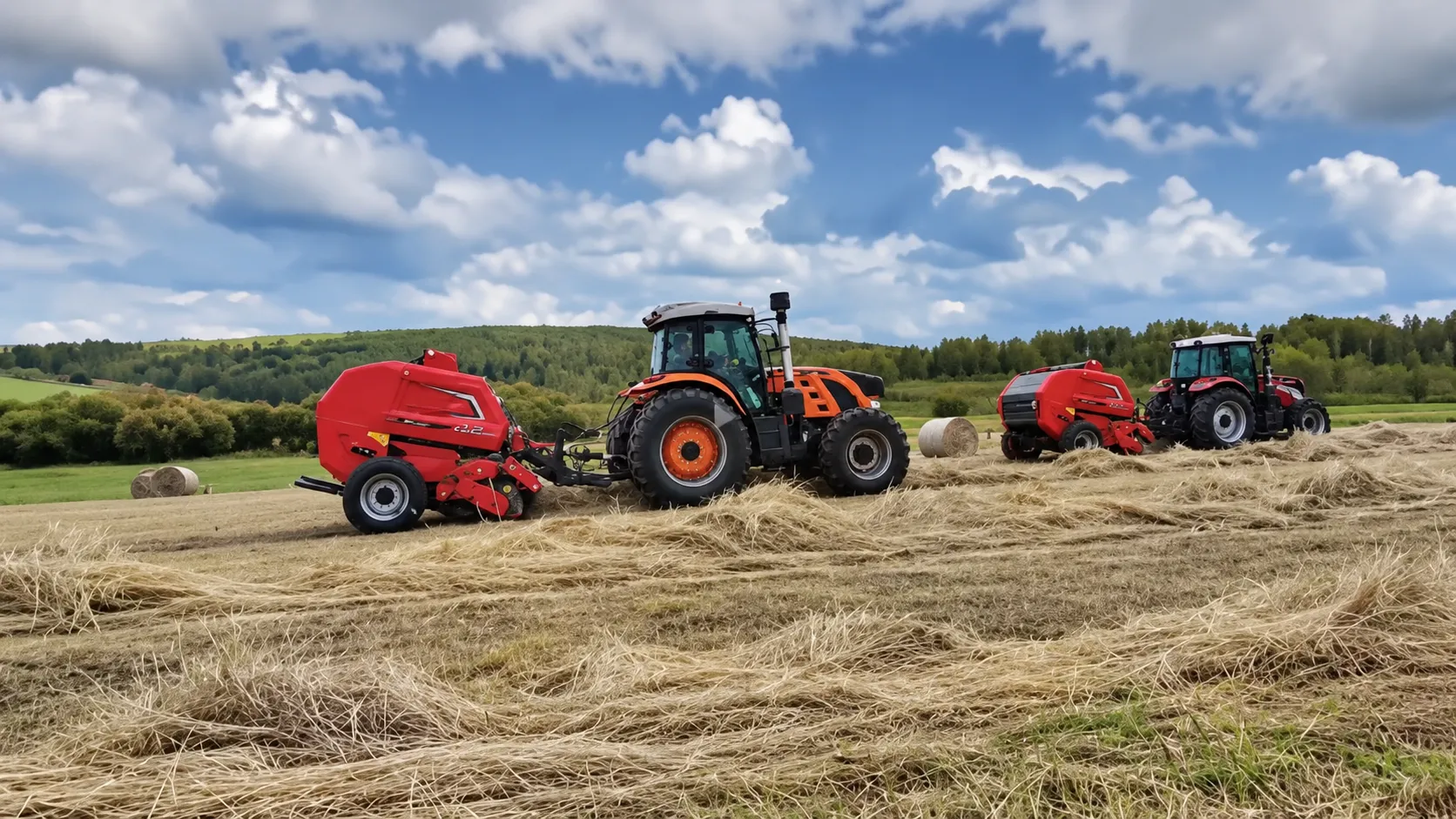
The Superior’s hitch geometry is genuinely useful in specific terrain conditions. If you operate primarily on flat ground, the standard S9000 or S9000 Classic will serve you equally well at lower cost. These are the situations where the Superior’s adjustable hitch delivers real, measurable returns:
Contour-Strip Hay Fields
Contoured strips follow grade lines across a hillside. The tractor runs along the contour at a lateral angle, and a fixed-hitch baler tilts with it — moving the pickup out of alignment with both the windrow and the ground. The Superior’s 30° lateral adjustment allows the pickup to remain level relative to the hillside surface while the tractor follows the contour without interrupting field speed.
Rolling Pasture in the Eastern US
Appalachian, Ozark, and mid-Atlantic pasture fields often have multiple grade changes across a single field — the tractor is going uphill, then across, then downhill, across the same run. The 100° horizontal swing eliminates power-cut turns on these layouts; the 30° lateral tilt handles side slopes without forcing the operator to choose between quality and speed.
Small Irregular Fields with Tight Headlands
Even on flat ground, the 100° horizontal swing has value in small fields. Fixed-hitch balers force the tractor to straighten up before engaging the PTO after a turn; the Superior’s dual-gearbox hitch maintains drive through the full turn arc, reducing the idle time at each headland and increasing the number of effective baling passes per hour.
Pacific Northwest Grass Seed & Hay
Western Oregon and Washington hillside grass fields can present side slopes of 15–25° alongside heavy, dense ryegrass or tall fescue windrows. The combination of steep grade and high-weight material creates exactly the conditions the Superior was designed for — the hitch manages the terrain geometry while the dual 20A rear chain handles the compression load.
Suitable Crops
Alfalfa, brome, fescue, orchardgrass, bermudagrass, timothy, and mixed pasture at below 18% moisture. Spring-tooth pickup handles fine and coarse material across varied windrow densities.
High-moisture cut grass or alfalfa at 30–50% for wrapped baleage. Higher compression force from dual 20A chains produces better bale density in wet, heavy material where lightweight chamber systems underperform.
Wheat, barley, oat, rye straw for bedding or biomass. The patented axial-flow intake clears large combine-header windrows at full field speed without blockage in light, fluffy straw conditions.
Post-harvest corn stover. The 20A chain system handles the density spikes common in stover pickup. For standing-stalk direct harvest, the 9YG-1.25 Hammer Claw model is more appropriate.
Cereal rye, triticale, hairy vetch, sorghum-sudan and mixed covers. The intake system moves tangled, fibrous cover crop material cleanly without the stem-wrapping issues that affect pickup systems with cam guides.
Flat through steep rolling — the Superior’s primary advantage over the other two S9000 variants. Lateral tilt adjustment up to 30° accommodates the steepest grades practical for tractor-and-baler operation.
S9000 Variant Comparison
| Feature | S9000 | S9000 Classic | S9000 Superior ← Here |
|---|---|---|---|
| Hitch Articulation | Fixed | Fixed | 100° swing / 30° tilt |
| Rear Chamber Drive | Standard chain | Dual-side sprocket | Dual 20A heavy chain |
| Compression Force | Standard | Higher (HD gearbox) | 500–1,000 kgf rated |
| Driveshaft | Standard single-joint | Dual crossjoint + limiter | Managed via gearbox hitch |
| Machine Weight | 3,922 kg / 8,647 lb | 4,312 kg / 9,504 lb | 4,570 kg / 10,076 lb |
| Best For | Flat fields, standard loads | Frequent turns, heavy driveline loads | Rolling / sloped / contoured terrain |
Maintenance — Superior-Specific Notes
- Grease both gearbox carrier pivot points — these carry the full lateral tilt load and are the highest-wear points in the assembly
- Verify lateral tilt adjustment mechanism moves freely through its full range before starting; stiffness indicates a seized pivot
- Check horizontal swing gear teeth are clean and lubricated at the interface with the carrier frame
- Confirm hitch pin is fully seated and safety clip installed before engaging PTO
- Check gearbox oil level in both carrier gearboxes — fill to sight glass center line
- Inspect 20A drive chain tension on both sides — equal tension is critical; unequal tension produces asymmetric roller speed
- Listen for any knocking or roughness in the gearboxes at low PTO speed before full engagement
- Inspect chain link plates for cracks, especially at the inner plates where side load is highest on grade operations
- Drain and replace gearbox oil in both carrier gearboxes — the operating angle range means the oil film is under more complex loading than a fixed-mount gearbox
- Full inspection of all pivot wear surfaces in the hitch assembly; measure and record play at each pivot point
- Replace 20A chain sets if inspection shows more than 1% elongation versus original pitch measurement
- Verify sensor cable routing has not been chafed by hitch movement over the season
Operator Reviews
Frequently Asked Questions
How steep a slope can the Superior practically operate on?
The hitch provides up to 30° of lateral tilt compensation — in theory enough to level the pickup on slopes up to approximately 30°. In practice, the limiting factor is tractor stability rather than baler geometry. Most agricultural tractors are rated for side slopes up to about 20–25° depending on configuration and loading. Operating a tractor and baler combination on grades steeper than the tractor’s rated side-slope limit creates rollover risk regardless of what the baler’s hitch can accommodate. The Superior extends your effective baling range on grade, but it does not extend your tractor’s safe operating limits. Always operate within the tractor manufacturer’s terrain ratings.
Does the dual-gearbox hitch require a different PTO shaft setup?
The Superior uses a standard 720 RPM PTO input — the same as the other S9000 variants. The dual-gearbox carrier manages angular compensation internally, which means the external PTO shaft from the tractor sees a more favorable operating angle in most field conditions compared to a standard fixed-hitch baler. You do not need a special PTO shaft or adapter to operate the Superior; the standard PTO shaft supplied with the machine is designed for the hitch’s operating geometry.
Is the lateral tilt adjustment manual or hydraulic?
The lateral tilt on the Superior’s hitch is mechanically adjusted — set by the operator before or during field operation by engaging the adjustment mechanism at the hitch carrier. It is not a hydraulically actuated system that can be changed from the cab in motion. Most operators set the tilt for the prevailing grade at the start of a run and readjust at the headland if the grade changes significantly. For fields with consistent grade, one setting typically covers an entire run without mid-field adjustment.
What does 500–1,000 kgf compression force mean in practical terms?
The rated 500–1,000 kgf range represents the force the dual 20A rear chamber chains can apply to compress material against the roller array. The lower end (around 500 kgf) applies in light, dry material where the bale builds relatively easily. The upper end (approaching 1,000 kgf) comes into play with heavy, dense, or wet material where higher force is needed to reach the target density. In practice, this range means the Superior can reach the same target density setpoint across a wider range of crop conditions without the chain drive system becoming the limiting factor — particularly relevant in multi-cut alfalfa or high-moisture cover crop baling where material resistance varies significantly within a single field.
Will bales roll downhill after ejection on a slope?
This is a genuine operational consideration on steep ground. Freshly ejected round bales on a grade will roll downhill if the surface is smooth enough and the grade is steep enough. The standard practice on hillside operations is to hold the tractor stationary after the gate drops — allowing the bale to stop rolling and settle into the stubble or grass — before driving forward. On very steep ground, some operators use a bale bumper or deflector to control bale travel direction at ejection. This is a field management question rather than a machine limitation, and the approach varies by terrain, crop stubble height, and operator preference.
Is this model appropriate for flat-ground operations?
The Superior performs well on flat ground — the dual 20A chains and patented intake deliver the same bale quality as the other S9000 variants. However, the hitch articulation features go unused on flat terrain, and the Superior carries an additional 258 kg (569 lb) over the S9000 Classic and 648 kg (1,429 lb) over the standard S9000. Operators working exclusively flat ground will likely find the standard S9000 or S9000 Classic a better value for their terrain.
How do I order spare parts from overseas?
Parts orders are placed directly through Brazil Ever-Power Farm Balers Co., Ltd’s sales team. Standard in-stock wear parts (pickup tines, chain sets, roller bearings, net wrap components) ship to US customers with an estimated 10–18 business day delivery by standard international freight. Specialty parts specific to the Superior’s gearbox hitch assembly may have longer lead times. We strongly recommend ordering a pre-season spare parts kit that includes the Superior-specific gearbox pivot bearing set, both 20A chain sets, pickup tines, and a roller bearing kit before the start of each baling season.
What other models in the range should I compare before deciding?
If your terrain is flat to gently rolling, compare the S9000 (standard, lowest cost) and S9000 Classic (driveline upgrades, small-field turns) before the Superior. If your fields are smaller with tighter headlands but moderate grade, the Classic may be the better fit. If you need silage baling with film wrap integrated, the 9YCM-850 Baler-Wrapper Combination is a separate product category worth reviewing. For all S9000 variants and the full product range, Brazil Ever-Power Farm Balers’ product catalog provides complete documentation.
Manufacturer
Brazil Ever-Power Farm Balers Co., Ltd
Brazil Ever-Power Farm Balers Co., Ltd is a national high-technology enterprise operating a 32,000 m² integrated production facility. The company maintains two dedicated assembly lines — one for round balers, one for mowing and raking equipment — each with 2,000-unit annual capacity. Manufacturing uses CNC laser cutting, automated welding, and electrostatic coating throughout with no outsourced fabrication of structural or mechanical primary components.
The company holds ISO 9001 certification, Two-Informatization Integration Level A status, AAA credit enterprise rating, and close to 100 utility patents across its product range. It has independent import and export rights and serves international markets including the United States, Mongolia, Russia, Belarus, and Kazakhstan. The company’s full product range — including all S9000 variants, the 9YG-1.25 series, the 9YG-1.0 and 9YG-1.0C models, and the 9YCM-850 baler-wrapper combination — is documented at Brazil Ever-Power Farm Balers’ product catalog.