Description
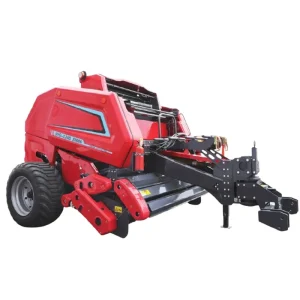
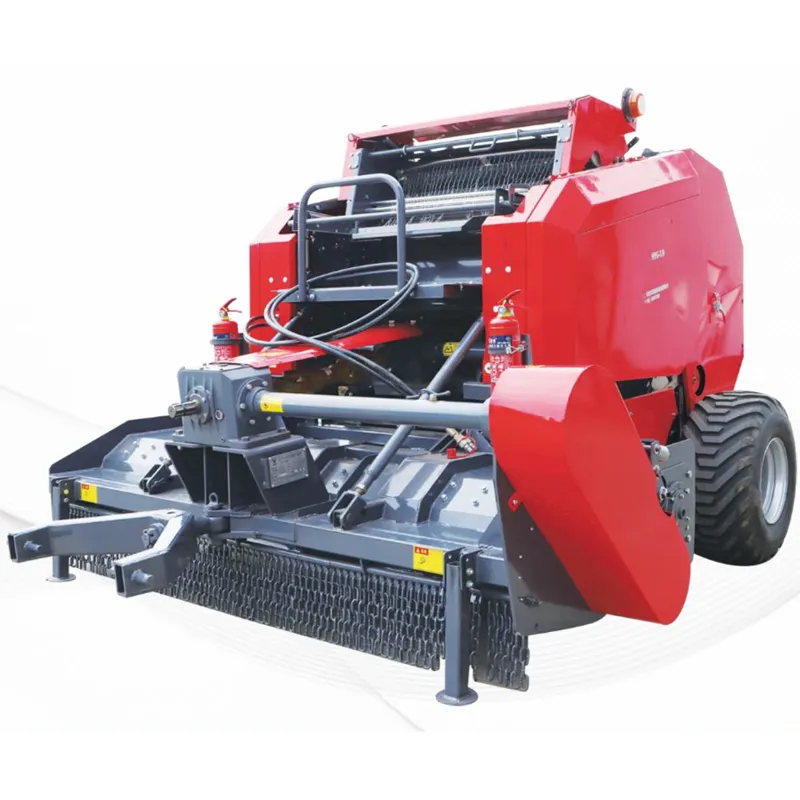
Stover collection economics favor simplicity. The fewer passes, the fewer machines, the fewer fuel loads — the more likely the math works out in favor of collecting. The 9YG-1.0C is designed around that logic: a compact, single-machine solution for standing corn stalk harvest that requires only 95 HP to operate and does not need a shredder or rake as pre-processing steps.
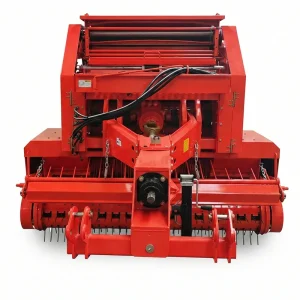
Its 94.5-inch (2,400 mm) hammer claw pickup is the widest in the farmbalers.com product range — wider even than the 9YH-1.25B’s 88.2-inch pickup. Twenty rotating hammer claws cover that full width, severing standing corn stalks near the base and feeding cut material directly into the 3-stage intake (auger + tooth roller + drum). The wider pickup translates to fewer overlap passes required across a corn field and faster field completion at the same forward speed.
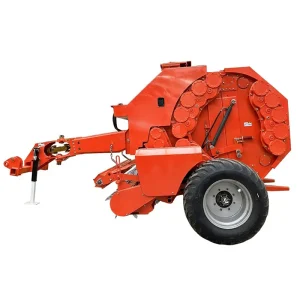
The bale format is compact: Φ1,000 × 1,250 mm — roughly 39 × 49 inches. These smaller bales weigh less per unit than the wider-chamber models, which suits operations handling bales with smaller loaders or moving stover for bedding in tight storage areas. The 16-roller chamber with dual 16A heavy chains on both sides of the rear drive achieves compression force high enough to produce tight, stackable bales from corn stover, which is a lower-density material than hay and requires adequate compression force to produce a bale that holds shape during handling.
The 540 RPM PTO rating is the key practical difference from the 9YH-1.25B hammer claw model, which requires 720 RPM. Any tractor with a standard 540 RPM rear PTO output — covering most US utility tractors from the 1990s onward above 95 HP — connects to the 9YG-1.0C without adapter. For the full product range, visit Brazil Ever-Power Farm Balers’ product catalog.
Technical Specifications
| # | Parameter | Unit | कीमत |
|---|---|---|---|
| 1 | Model Name | — | 9YG-1.0C Round Baler (Hammer Claw) |
| 2 | Hitch Type | — | Towed (Drawbar) |
| 3 | पिकअप चौड़ाई | mm / in | 2,400 mm (94.5 in) — Widest in Range |
| 4 | Pickup Type | — | Hammer Claw (Fixed, Not Interchangeable) |
| 5 | Hammer Claw Count | pcs | 20 |
| 6 | Feed System | — | Auger + Tooth Roller + Drum (3-Stage) |
| 7 | Chamber Type | — | Fixed-Chamber Roller |
| 8 | Chamber Width | mm / in | 1,250 mm (49.2 in) |
| 9 | Chamber Diameter | mm / in | Φ 1,000 mm (39.4 in) |
| 10 | Number of Rollers | pcs | 16 |
| 11 | Roller Diameter | mm | 222 mm (8.7 in) |
| 12 | Rear Chamber Drive | — | Dual 16A Heavy Chain, Both Sides |
| 13 | Wrapping System | — | Automatic Net Wrap (Standard) |
| 14 | Tractor Power Required | kW / HP | ≥69.8 kW (≥95 HP) |
| 15 | PTO Speed | RPM | 540 |
| 16 | Machine Weight | kg / lb | 3,198 kg (7,050 lb) |
| 17 | Overall Dimensions (L×W×H) | mm | 3,800 × 2,850 × 2,200 (working) |
| 18 | Bale Density Control | — | Electronic Sensor |
| 19 | Bale Size (Dia. × Width) | mm / in | Φ 1,000 × 1,250 mm (39 × 49 in) |
| 20 | गांठ घनत्व | kg/m³ | 115–200 |
| 21 | Productivity | bales/hr | 40–80 |
| 22 | Track Width | mm | 2,100 |
| 23 | Operating Speed | km/h / mph | 5–20 km/h (3–12 mph) |
| 24 | Net Wrap Specification | — | 2,000 × 1.25 m per bale |
What Makes the 9YG-1.0C Distinct
Four features that differ from both the compact 9YG-1.0 and the full-size 9YH-1.25B hammer claw model
94.5-Inch Hammer Claw — 6.3 Inches Wider Than 1.25B
The 9YG-1.0C’s 2,400 mm pickup is the widest in the entire farmbalers.com range — 160 mm wider than the 9YH-1.25B’s 2,240 mm. In corn stover terms, that additional 6.3 inches of coverage width means the machine spans one to two additional rows per pass depending on row spacing, reducing the total number of passes needed across a given field and improving field completion time at the same forward speed.
540 RPM — Runs on Standard Legacy Tractors
The 9YH-1.25B requires 720 RPM PTO — a standard available on most modern tractors but absent on older 540-only machines. The 9YG-1.0C runs at 540 RPM, which means any US tractor from approximately 95 HP upward with a standard rear PTO output connects directly without adapter. For farms running older utility tractors in the 95–120 HP range alongside corn production, this is the critical practical difference between the two hammer claw models.
Dual 16A Heavy-Duty Chain, Both Sides
The standard 9YG-1.0 uses a single-side drive chain. The 9YG-1.0C upgrades to dual 16A heavy-duty chains running on both sides of the chamber simultaneously. As with the dual-side drive on the S9000 Classic, this distributes the compressive load symmetrically across both sides of the roller assembly — improving density consistency across the 1,250 mm bale width and extending chain service life by operating each side at a lower fraction of its rated capacity. Corn stover is lower density than hay, making adequate compression force more critical to bale integrity; the dual-chain system provides that force reliably.
7,050 lb — Lightest Hammer Claw Baler in the Range
At 3,198 kg (7,050 lb), the 9YG-1.0C is 3,004 lb lighter than the 9YH-1.25B (10,054 lb) and 2,307 lb lighter than the lightest S9000 variant (9,353 lb). Lower machine weight means less soil compaction in post-harvest stover fields where the combine has already made passes, less fuel burned per bale moving the implement mass, and more compatibility with smaller drawbar-rated tractors in the 95–110 HP range that may be rated for lower drawbar pull than heavier machines require. Smaller bales also weigh less individually — easier handling with compact loaders common on smaller corn operations.
How the Hammer Claw Works
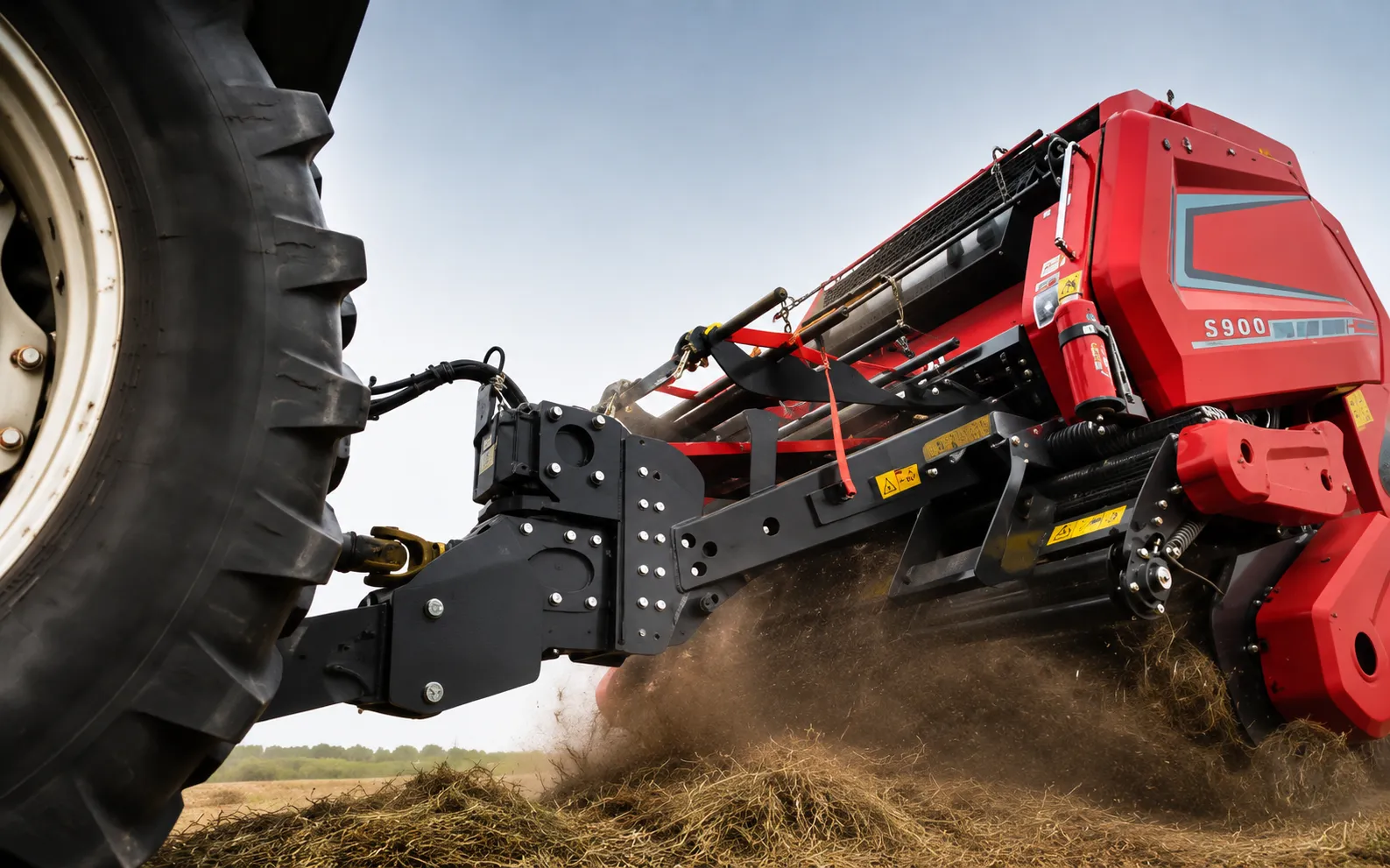
The 20 hammer claws are mounted on a rotating shaft assembly spanning the full 2,400 mm pickup width. When the machine advances into standing corn stalks at 3–12 mph, the claws — rotating at high speed relative to tractor forward travel — strike standing stalks near the base and sever them through impact force. The severed material is swept upward and rearward into the three-stage intake.
The auger moves cut stover laterally across the chamber width; the tooth roller meters its flow rate; the drum delivers it into the 16-roller compression chamber. Because the chamber geometry is fixed, bale diameter is constant at Φ1,000 mm — smaller than the 1.25B’s Φ1,200 mm, which means the chamber fills faster per unit of material. At comparable material density and forward speed, the 9YG-1.0C completes more bale cycles per hour than the larger 1.25B chamber, partially compensating for the smaller individual bale volume.
Important: Fixed hammer claw — not interchangeable
Unlike the 9YH-1.25B, the 9YG-1.0C does not have an interchangeable spring-tooth pickup option. The hammer claw is the only available pickup for this model. If your operation requires both stover direct harvest and windrow hay baling, choose the 9YH-1.25B, which ships with both pickup assemblies. The 9YG-1.0C is a dedicated stover harvesting tool.
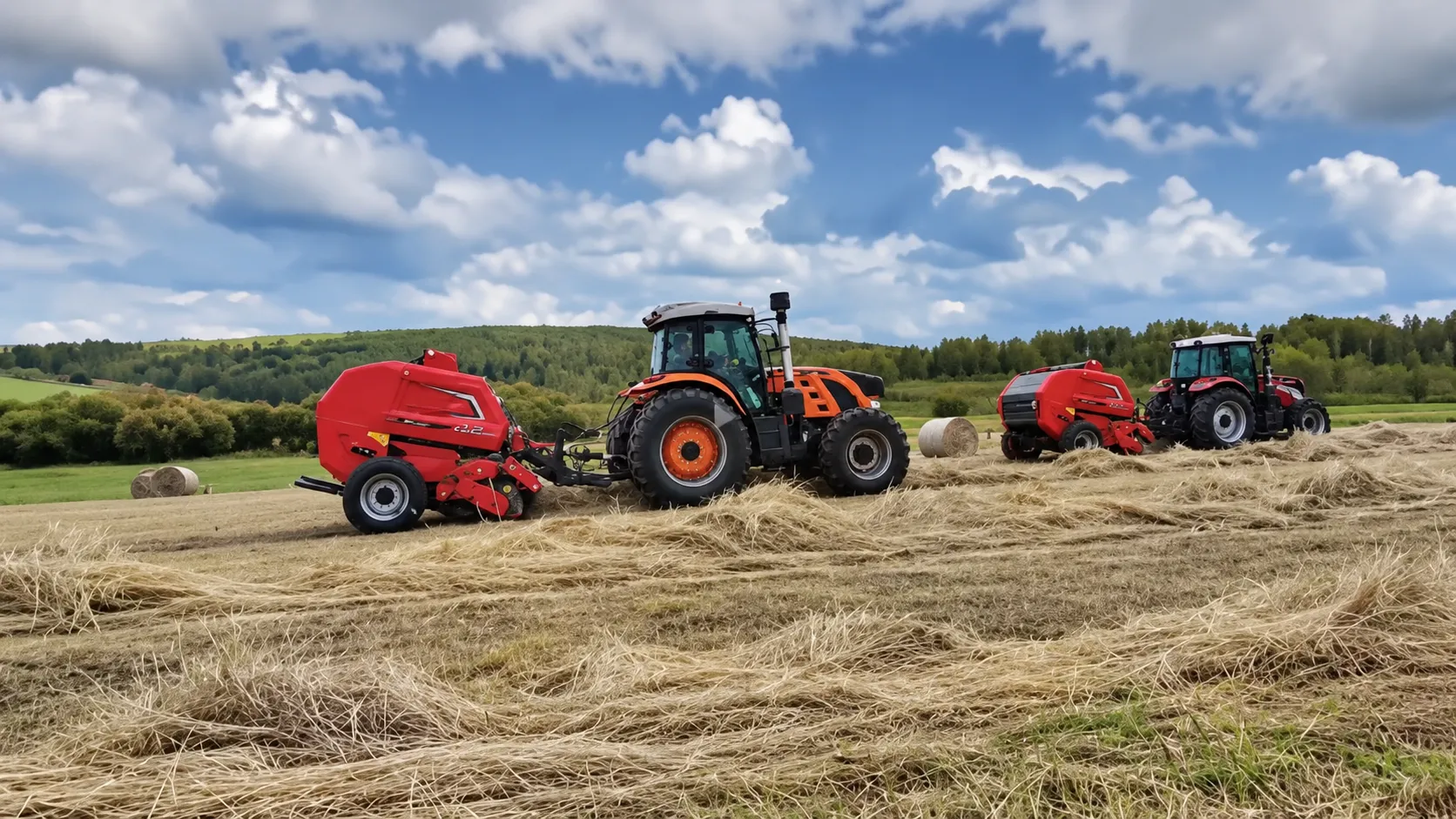
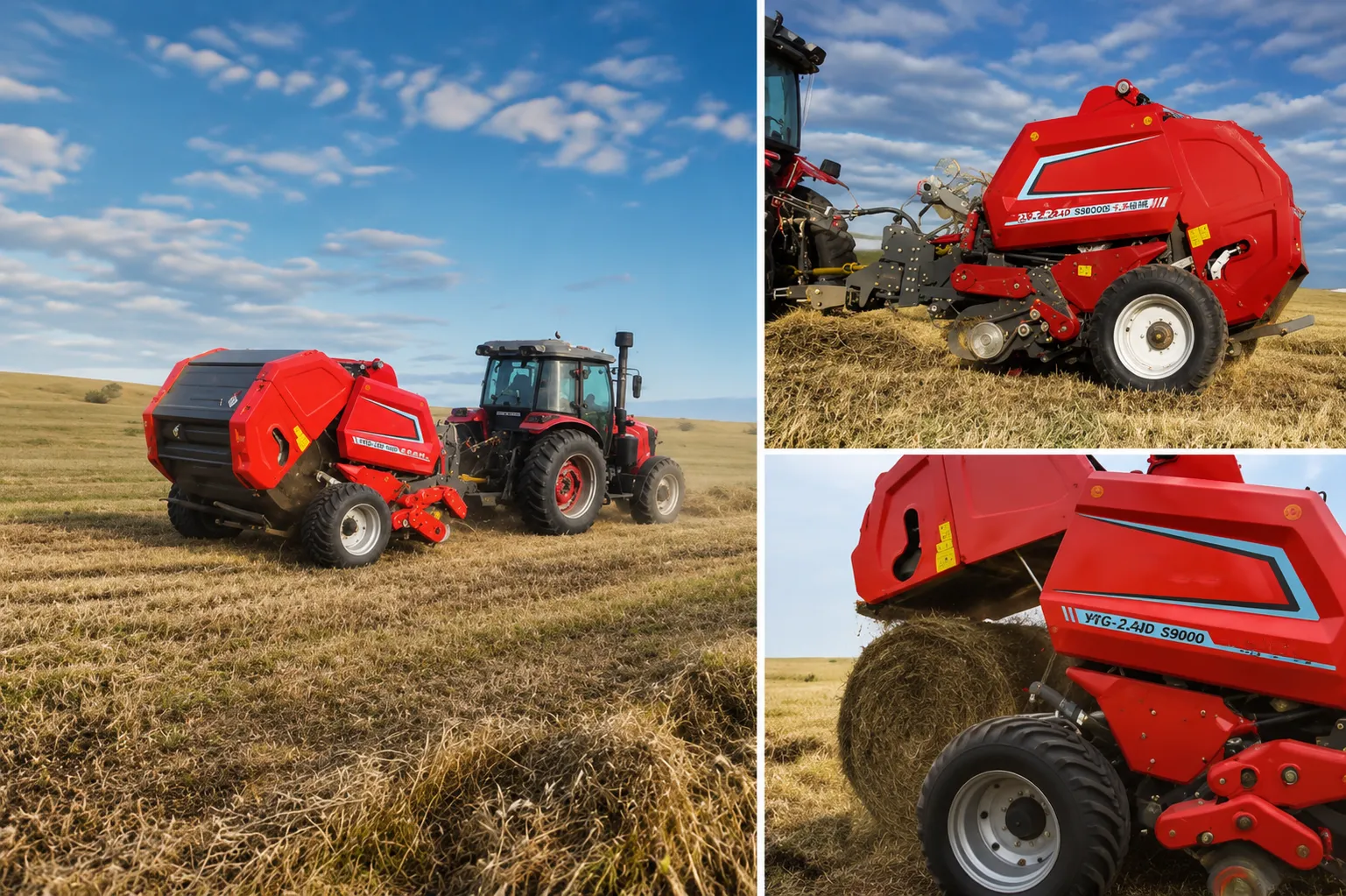
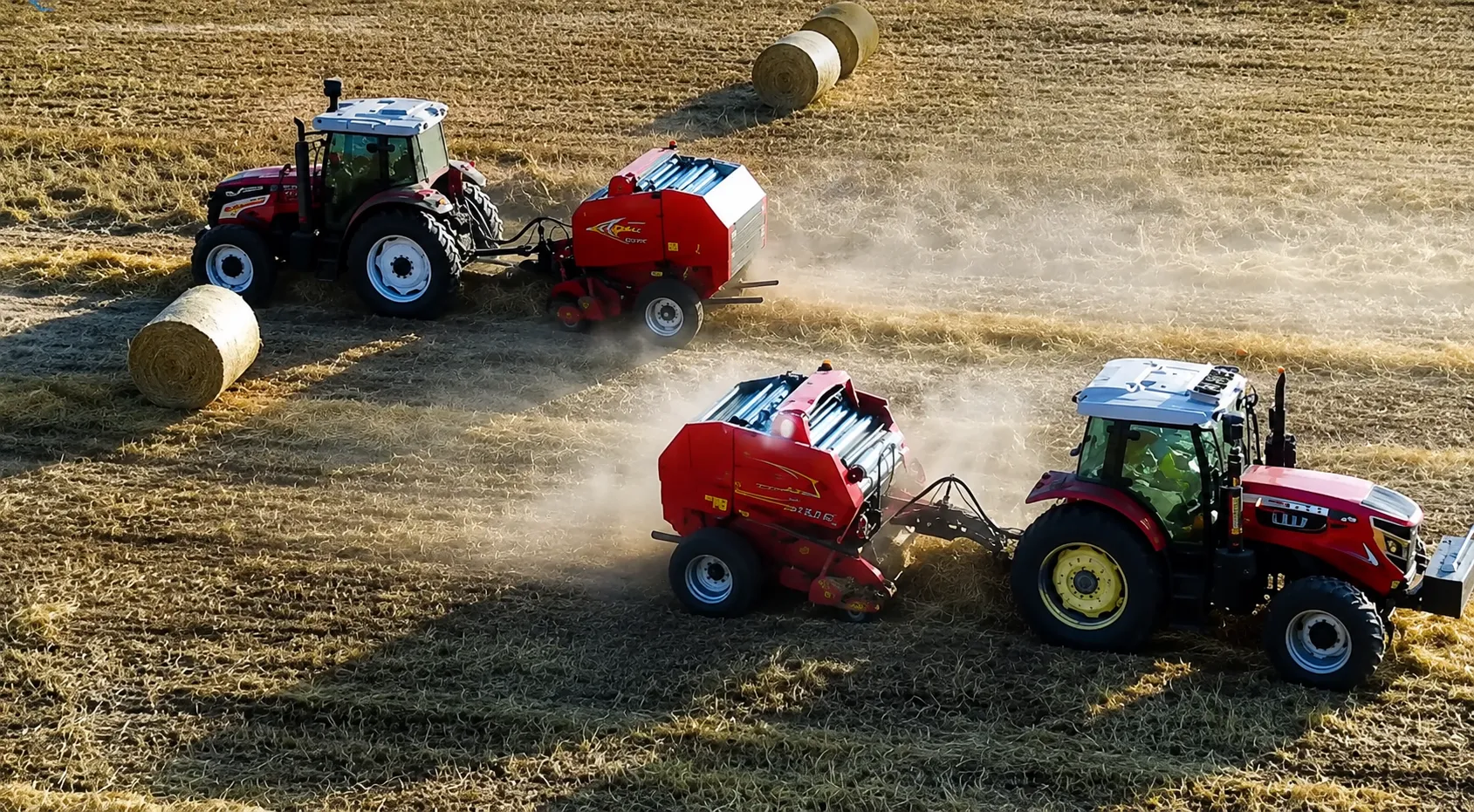
Field Operation — Corn Stover Mode
Confirm all 20 hammer claws are secure — torque check fasteners before each session. Set claw height to skim just above the soil surface. Engage PTO at low throttle before entering the corn field to bring the claw assembly to operating speed. Check that the 540 RPM PTO is selected on the tractor and fully engaged before advancing into standing stalks.
Advance at 4–8 km/h (2.5–5 mph) in standing corn stalks. The 9YG-1.0C’s smaller bale format fills the chamber faster than the 1.25B, so field speed in stover can be maintained at the higher end of this range in typical post-combine residue. Reduce speed in unusually dense residue or where the combine left concentrated windrows at row ends. Maintain consistent speed rather than varying — surging produces uneven bale cores.
The sensor triggers net wrap when the bale reaches the density setpoint. Slow to near-idle during the wrap cycle — do not maintain field speed through the wrap sequence. Net is applied across the 1,250 mm bale face, cut, and the gate opens automatically. Typical cycle in stover: 20–30 seconds net-wrap-to-gate-closed. Gate latches without manual action; resume forward travel once the gate close signal shows on the control panel.
The Φ1,000 × 1,250 mm compact bale format weighs approximately 400–650 lb in typical corn stover conditions — manageable with a small round bale spike or compact loader. The lighter per-bale weight is an advantage when stacking in low-clearance storage or moving bales short distances without a telehandler. Stack no more than 2–3 bales high without structural support, as corn stover bales are lower density and less stable than hay bales of the same dimensions.
उत्पादन
In-House Production — ~100 Utility Patents
All Brazil Ever-Power Farm Balers Co., Ltd equipment is designed and manufactured in-house at a 32,000 m² facility. The company holds close to 100 utility patents and operates CNC laser cutting, robotic welding, and electrostatic coating lines. No primary structural or mechanical components are outsourced. Certifications: ISO 9001, Two-Informatization Integration Level A, AAA Credit Enterprise, National High-Technology Enterprise.

Hammer Claw Model Comparison
| Feature | 9YG-1.0C ← Here | 9YH-1.25B |
|---|---|---|
| पिकअप चौड़ाई | 94.5 in (2,400 mm) | 88.2 in (2,240 mm) |
| PTO Speed | 540 RPM | 720 RPM |
| Min HP | 95 HP | 120 HP |
| Machine Weight | 7,050 lb | 10,054 lb |
| Bale Format | 39 × 49 in | 47 × 49 in |
| Hammer Claws | 20 | 18 |
| Spring-Tooth Swap Option | ✗ Dedicated stover only | ✓ Both pickups included |
| Best For | Dedicated stover, smaller tractors, lighter machine needed | Dual-use — stover AND hay/straw baling in one machine |
Suitable Crops & Conditions
Post-combine standing corn stalks harvested directly without shredding or raking. The 94.5-inch claw width covers 30-inch corn rows approximately 4 rows wide per pass, reducing the total pass count across a given field compared to the 88-inch 1.25B model.
Upright sorghum stalks and similar standing fibrous residue not yet fallen or raked. The hammer claw impact mechanism handles stems up to approximately 20–25 mm base diameter at operating speeds. For lodged or fallen material, the spring-tooth pickup on the 9YH-1.25B handles that better.
The 9YG-1.0C’s hammer claw is not optimized for raked windrows. If your stover has been shredded and raked, switch to a spring-tooth baler for that material — the claw action unnecessarily shreds already-processed material and degrades bale uniformity. This machine is designed for direct standing-stalk harvest only.
Flat to gently rolling. The 9YG-1.0C’s compact dimensions (3,800 × 2,850 mm working) and lighter weight suit flat to slightly undulating corn ground. For steep side slopes, consider the S9000 Superior.
Any tractor providing ≥95 HP at the 540 RPM PTO. Older mid-range utility tractors (95–120 HP) from Case IH, John Deere, New Holland, Massey Ferguson, and Kubota that provide standard 540 RPM rear PTO connect directly without adapter.
The compact bale format (39 × 49 in, 400–650 lb stover) and lighter machine weight make this the practical choice for corn operations below 600 acres of stover collection. Above that volume, the larger bale format of the 9YH-1.25B reduces per-bale handling cycles.
Maintenance
- Torque-check all 20 claw fasteners — stover claw bolts loosen faster than other fasteners; daily check is not optional
- Inspect each claw for cracks or tip wear — replace any damaged claw before field entry
- Set claw height for soil clearance
- Grease all lubrication points — claw shaft bearings, roller ends, chain idlers
- Confirm 540 RPM PTO engages smoothly at low throttle before entering standing stalks
- Re-torque all claw fasteners — stover mode runs on a 20-hour retorque cycle, not 50-hour
- Inspect claw tips: replace when tip length is reduced by more than 15%
- Check dual 16A chain tension on both sides — equal tension required
- Clean stover fibre from claw shaft and auger
- Replace any claws showing tip wear over 20%
- Inspect claw shaft bearings for play
- Drain and replace gearbox oil
- Inspect both 16A drive chains — replace if stretch exceeds 1% of original pitch
- Clean, dry, and apply anti-corrosion spray to all claw assembly components before storage
Operator Reviews
West-Central Indiana — 480 acres corn, stover for cattle bedding
★★★★★
We have 480 acres of corn and collect stover every year for bedding our beef cattle. Our baler tractor is a 2001 110 HP unit with 540 RPM PTO only — which ruled out the 9YH-1.25B from the start. The 9YG-1.0C connects directly to our tractor without any adapter and works cleanly at 540 RPM. The 94.5-inch pickup covers about 4 rows of our 30-inch corn per pass, which is wider than we expected from a compact machine — we complete a 50-acre field noticeably faster than with the shredder-rake-baler approach we used before. The compact bales handle fine with our existing 500 lb-capacity bale spear. We put 2,800 bales through it in the first season with only routine maintenance — claw retorquing as required and one claw replacement at about 1,900 bales from tip wear. Very satisfied.
Central Ohio — 320 acres corn, 540-RPM tractor fleet
★★★★☆
Running older tractors here — two Magnum 7120 units from the early 1990s, both 540 RPM only. The 9YG-1.0C was the only hammer claw baler I found in this price range that doesn’t need 720 RPM. It worked directly with both tractors without any drivetrain modification. Stover baling performance has been good — the wider pickup is a genuine advantage over narrower machines I’ve used before; fewer passes per field, less time total. I’m giving four stars rather than five because the compact bale format takes more trips to move from the field to the storage barn than I’d like — my neighbor has a 55-inch format baler and his per-trip haul count is better. I understand why the bale is smaller on this machine, and it works for my operation, but buyers with large haul distances should factor in the smaller bale size when comparing against the 1.25B.
Northern Missouri — 550 acres corn, biomass market stover
★★★★★
I sell corn stover into a biomass market and needed to cut collection cost to make it profitable. The three-pass conventional approach — shredder, rake, baler — was killing the margin. The 9YG-1.0C one-pass collection has changed that calculation significantly. At 550 acres I run approximately 2,200–2,400 bales per season. The 94.5-inch pickup covers my 30-inch corn rows about 4 rows wide per pass; I can complete a 40-acre field in roughly 90 minutes once the combine has been through, versus 6–7 hours total for the three-pass approach. That time saving is what makes the math work. The machine has been reliable — one claw set replacement over 4,400 bales total in two seasons. Parts lead time was about 12 days on the replacement claws. Planning ahead on parts is the main thing buyers need to know.
Eastern Illinois — 700 acres corn, dairy cattle bedding
★★★★☆
We use stover for dairy bedding across a 300-head operation. The 9YG-1.0C has simplified our fall stover workflow substantially — we go into the corn field right behind the combine and bring bales directly to the bedding storage. The 540 RPM compatibility was important because we dedicate an older 105 HP tractor to this job during fall. Bale quality has been consistent enough for bedding purposes. I give four stars because at 700 acres, the smaller bale format creates more handling events than I’d prefer. We move a lot of bales and each one is lighter, which adds loader cycles. If you’re at or above 600 acres, look seriously at the 9YH-1.25B’s larger bale size before deciding — the additional HP requirement and higher cost may pay back in reduced handling time over a full season.
Western Iowa — 1,100 acres corn, commercial stover program
★★★☆☆
I’ll be straight with you: the 9YG-1.0C is a solid machine that I outgrew. At 1,100 acres of stover, the compact bale format creates a handling bottleneck — too many individual bales to move, too many loader cycles, too many transport loads. The machine itself bales fine and the single-pass collection works as described. But at this volume, I needed the larger bale format of the 9YH-1.25B, and I should have bought that from the start. I sold the 9YG-1.0C and moved up. Three stars is not a quality complaint — the machine is well-built and does what it says. It’s an honest signal about scale ceiling: if you’re above 600–700 acres of stover collection per season, the larger hammer claw model is the better investment. Below that, the 9YG-1.0C is efficient and cost-effective.
Frequently Asked Questions
Can I add a spring-tooth pickup to the 9YG-1.0C?
No. The 9YG-1.0C is a dedicated stover harvesting machine; its hammer claw pickup is fixed and not interchangeable with a spring-tooth assembly. If you need a single machine that can bale both standing corn stover and windrowed hay or straw, the 9YH-1.25B ships with both pickup assemblies and swaps between modes in the field.
Why does the 9YG-1.0C have a wider pickup than the 9YH-1.25B if it’s the smaller machine?
The 9YG-1.0C’s 94.5-inch pickup is designed specifically for standing corn row coverage — a wider claw head covers more rows per pass even when the bale chamber itself is smaller. The 9YH-1.25B uses its 88.2-inch pickup for both hay and stover modes and is sized for general-purpose versatility rather than maximum stover coverage width. The 9YG-1.0C trades the hay capability for a wider stover collection footprint.
How many rows of 30-inch corn does the 94.5-inch pickup cover per pass?
At 30-inch (762 mm) row spacing, the 94.5-inch (2,400 mm) pickup covers approximately 3.15 rows — in practice, operators typically align for 3 full rows per pass with slight overlap. At 36-inch row spacing, coverage is approximately 2.6 rows. In 20-inch row spacings used in some high-yield corn systems, coverage extends to approximately 4.7 rows. The actual pass count depends on how precisely the tractor follows row alignment and how much adjacent-row claw impact the operator accepts.
What does the compact bale size mean for transport and storage?
The Φ1,000 × 1,250 mm bale (approximately 39 × 49 inches) holds less material per unit than the 47 × 49-inch bale from the 9YH-1.25B and significantly less than the 51 × 55-inch bale from the S9000 or 9YH-1400 series. For on-farm stover collection with a compact loader and short haul distances, the lighter per-bale weight (400–650 lb in typical stover) is an advantage. For operations with long haul distances or commercial stover markets, the smaller bale format increases transport cost per ton — calculate whether the 9YH-1.25B’s larger bale pays back its higher purchase cost through lower handling cost per ton at your specific volume.
Is the dual 16A chain the same as the dual 20A chain on the S9000 Classic?
No. 16A and 20A designations refer to chain pitch and load ratings — 20A chain is a higher-load specification than 16A. The dual 16A chains on the 9YG-1.0C are appropriate for the smaller 1,000 mm diameter chamber and the lower-density material (corn stover) typically processed. The dual 20A chains on the S9000 Classic and S9000 Superior are sized for the larger 1,200 mm diameter chamber and the higher compression forces required in heavy hay and silage applications. Both configurations use dual-side drive to distribute load symmetrically; the chain grade is matched to each machine’s specific load demands.
How do I get replacement hammer claws in the US?
Individual claw replacement kits are available through Brazil Ever-Power Farm Balers Co., Ltd’s spare parts program. Order directly through the sales contact. Standard lead time to US destinations is 10–18 business days. We recommend stocking 6–8 spare claws before each stover season — claw wear rate varies significantly with soil abrasiveness and residue conditions, and mid-season replacements without stock on hand create avoidable downtime. Full product documentation is at Brazil Ever-Power Farm Balers’ product catalog.
Should I buy the 9YG-1.0C or the 9YH-1.25B?
Buy the 9YG-1.0C if: you have a 540-RPM-only tractor between 95–120 HP; you want the widest possible stover coverage per pass; your operation is below 600–700 acres of stover per season; and you only need stover harvest, not a dual-use hay baler. Buy the 9YH-1.25B if: you need to bale hay AND corn stover with one machine; your tractor provides 720 RPM; you’re above 600–700 acres of stover and want larger per-bale volume; or your downstream handling equipment is sized for the 47-inch bale format.
Manufacturer
Brazil Ever-Power Farm Balers Co., Ltd
Brazil Ever-Power Farm Balers Co., Ltd is a national high-technology enterprise with a 32,000 m² in-house manufacturing facility, two dedicated assembly lines at 2,000-unit annual capacity, close to 100 utility patents, and independent import and export rights. All products are designed internally and manufactured using CNC laser cutting, automated welding, and electrostatic coating — no primary components outsourced. ISO 9001, Two-Informatization Integration Level A, and AAA Credit Enterprise certified. Markets served include the United States, Mongolia, Russia, Belarus, and Kazakhstan.
Full product documentation at Brazil Ever-Power Farm Balers’ product catalog.